• Welcome to Christianity Haven, thank you for visiting! If you have not already, we invite you to create an account and join in on the many discussions we have! 

    • Please be aware that when registering you must not register while using a VPN. Any registrations made using a VPN will be rejected.
    • Additionally, registration emails are not being sent out which is an issue that is being worked on. Your registration may go into an approval queue for admin approval. We work to send manual emails to the email on file, so please ensure the email you use is one you can readily access! 

How has Reformation Day changed your life?

Lamb

God's Lil Lamb
Community Team
Administrator
Supporting Member
Joined
Jun 10, 2015
Messages
34,524
Age
59
Gender
Female
Religious Affiliation
Lutheran
Political Affiliation
Conservative
Marital Status
Married
Acceptance of the Trinity & Nicene Creed
Yes
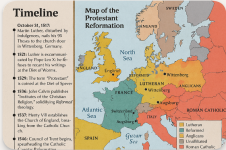
We might not realize all the ways that the Reformation has changed us, that day on October 31, 1517 when Martin Luther nailed the 95 theses to the church door at Wittenberg, Germany.

I think the main thing is that salvation "by grace through faith" was brought back to the churches because of the Reformation.
 

Frankj

Well-known member
Joined
Nov 11, 2024
Messages
923
Gender
Male
Religious Affiliation
Non-Denominational
Acceptance of the Trinity & Nicene Creed
Yes
It's interesting to think of the significance of the day he posted them, and what would have come of them if he had just taken them quietly to the Church authorities in some back room somewhere and presented them there. What might have become of him as well.
 

jswauto

Well-known member
Joined
Apr 19, 2025
Messages
600
Gender
Male
Religious Affiliation
Charismatic
Marital Status
Married
Acceptance of the Trinity & Nicene Creed
Yes
It's interesting to think of the significance of the day he posted them, and what would have come of them if he had just taken them quietly to the Church authorities in some back room somewhere and presented them there. What might have become of him as well.
Martin Luther would of been: Drawn, quartered, tortured, and then hanged or burned as a heretic. Maybe not in that order. It would not have gone well for him though. It didn't go that well when he posted them.


A Short Synopsis
On October 31, 1517,
Martin Luther posted his 95 Theses on the Castle Church door in Wittenberg, Germany, igniting the Protestant Reformation and reshaping Western Christianity.
This act—both symbolic and strategic—marked a turning point in religious, cultural, and political history. Here's a deeper look at what happened and why it mattered:

🔨 The Event: Luther’s Bold Challenge
• Martin Luther, an Augustinian monk and theology professor, was deeply troubled by the Catholic Church’s sale of indulgences—payments made to reduce punishment for sins.
• On October 31, 1517, the eve of All Saints’ Day, Luther nailed his “Disputation on the Power and Efficacy of Indulgences” (the 95 Theses) to the door of the Castle Church in Wittenberg. This door functioned as a public bulletin board for academic debate.
• His theses were written in Latin, intended for scholarly discussion, but they quickly spread thanks to the printing press, reaching a wide audience across Europe.

📜 The Content: What Luther Argued
• The first thesis declared: “When our Lord and Master Jesus Christ said, ‘Repent,’ he willed the entire life of believers to be one of repentance.”
• Luther challenged the authority of the pope, the validity of indulgences, and the idea that salvation could be bought or earned through rituals.
• He emphasized faith, grace, and Scripture as the true foundations of Christian life.

🔥 The Impact: Reformation Ignited
• Though initially intended as an academic debate, Luther’s action sparked a religious revolution.
• The Protestant Reformation led to the formation of new Christian denominations, including Lutheranism, and shattered the Catholic Church’s monopoly on spiritual authority in Europe.
• It also fueled literacy, education, and democratic ideals, as people were encouraged to read the Bible and think critically about religious and political authority.

🕯️ Legacy: Reformation Day
• October 31 is now commemorated as Reformation Day by many Protestant churches.
• Luther’s courage and conviction continue to inspire movements for truth, reform, and spiritual renewal.

Screenshot 2025-11-07 203515.png


🔨 The Hammer Heard Around Christendom

Wittenberg, Saxony — October 31, 1517

The autumn air was crisp, the cobblestone streets of Wittenberg quiet but expectant. As the eve of All Saints’ Day approached, pilgrims from across Saxony prepared to visit the Castle Church, where relics were displayed and indulgences promised spiritual merit. But on this day, a monk named Martin Luther, armed not with sword or scepter but with parchment and conviction, approached the church door with a document that would shake the foundations of Western Christendom.
He carried ninety-five propositions, written in Latin, challenging the theological legitimacy and ecclesiastical abuse of indulgences—a practice where the Church claimed to reduce punishment for sin in exchange for money. Luther, a professor of theology at the University of Wittenberg and an Augustinian friar, had wrestled deeply with the Scriptures and the soul’s need for grace. His theses were not a call to schism, but a summons to scholarly debate. Yet the implications were revolutionary.

📜 The 95 Theses: A Theological Broadside
Luther’s first thesis struck at the heart of Christian life:
This was not mere academic quibbling. Luther was asserting that true repentance was internal, spiritual, and lifelong, not transactional or mediated by papal authority. He questioned:
• The efficacy of indulgences to remit sin or reduce time in purgatory.
• The authority of the pope to grant such spiritual benefits.
• The commercialization of salvation, which preyed on the poor and ignorant.
He argued that salvation was by faith alone (sola fide), through grace alone (sola gratia), and grounded in Scripture alone (sola scriptura)—a radical departure from the sacramental system of the medieval Church.

🖨️ Printing Press and Public Uproar
Though intended for academic debate, Luther’s theses were quickly translated into German and spread like wildfire thanks to the recent invention of the printing press. Within weeks, they reached cities across the Holy Roman Empire. What had begun as a local protest became a continental movement.
The theses ignited public outrage, clerical backlash, and imperial scrutiny. Pope Leo X dismissed Luther as a “drunken German” who would “change his mind when sober.” But Luther did not recant. Instead, he doubled down, publishing sermons, treatises, and translations that empowered laypeople to read Scripture and question authority.

⚔️ Strategic and Spiritual Fallout
Luther’s act was not just theological—it was strategic resistance. By posting his theses on the eve of All Saints’ Day, he ensured maximum visibility. By challenging indulgences, he struck at a major source of Church revenue. By appealing to Scripture and conscience, he bypassed ecclesiastical hierarchy.
The consequences were seismic:
1521: Luther was excommunicated and declared an outlaw at the Diet of Worms.
1522: He returned from hiding to lead reforms in Wittenberg.
1530: The Augsburg Confession formalized Lutheran doctrine.
1546: Luther died, but the Reformation surged on.

🕯️ Legacy and Reformation Day
October 31 is now commemorated as Reformation Day, especially in Lutheran and Reformed traditions. Luther’s courage birthed not only new denominations but also:
• Biblical literacy among the laity.
• Checks on ecclesiastical power.
• Seeds of democratic thought, as conscience and Scripture became central.

Screenshot 2025-11-07 221625.png


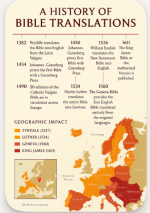
📜 Timeline of Bible Translations (1382–1611)

This parchment-style timeline highlights key milestones in the translation of the Bible into vernacular languages:
1382: Wycliffe translates the Bible into English from the Latin Vulgate
1454: Gutenberg prints the first Bible using movable type
1526: Tyndale publishes the New Testament in English from Greek
1534: Luther completes the full German Bible
1560: Geneva Bible offers the first full English translation from original languages
1611: King James Bible is published, shaping English Christianity for centuries

🗺️ Geographic Impact Map
The lower half of the infographic shows Europe color-coded by translation influence:
Tyndale (1537): Light orange — England and parts of Scotland
Luther (1534): Burnt orange — Germany, Scandinavia, and parts of Eastern Europe
Geneva (1560): Coral — Switzerland, France, and the Netherlands
King James (1611): Deep red — England and its colonies
 

Attachments

  • Screenshot 2025-11-07 204036.png
    Screenshot 2025-11-07 204036.png
    308.5 KB · Views: 3
Last edited:

jswauto

Well-known member
Joined
Apr 19, 2025
Messages
600
Gender
Male
Religious Affiliation
Charismatic
Marital Status
Married
Acceptance of the Trinity & Nicene Creed
Yes
The Wittenberg Printing Press
The Wittenberg printing press, though not the first of its kind, became a strategic engine of Christian evangelism during the Reformation, transforming Martin Luther’s theology into a mass movement and making Scripture accessible to ordinary people.

🖨️ Origins and Strategic Rise of Wittenberg’s Press
• While Johannes Gutenberg invented the movable-type printing press around 1440, it was Wittenberg’s press, fueled by Luther’s writings, that became the epicenter of religious publishing in the 16th century.
• In 1517, Wittenberg was a modest university town with only one printing press. But after Luther posted his 95 Theses, demand for his writings exploded.
• By the end of the century, Wittenberg had published more books than any other city in the Holy Roman Empire, surpassing major trade hubs like Nuremberg and Cologne.

📚 Evangelism Through Print: Luther’s Mastery of the Medium
• Luther recognized the power of print to evangelize, educate, and reform. Between 1517 and 1525, he published over half a million works, becoming the first bestselling author of the Early Modern period.
• His writings were translated into German, making theology and Scripture accessible to laypeople for the first time.
• The press enabled rapid distribution of:
• Pamphlets and sermons challenging Church authority
• German Bibles, which empowered personal Bible study
• Catechisms and hymnals, used in homes and congregations

🎨 Visual Evangelism: Cranach’s Role
• Luther’s ally, Lucas Cranach the Elder, designed woodcut illustrations and title pages that made theological texts visually engaging and memorable.
• These images helped illiterate audiences grasp biblical truths, reinforcing the message through art.

🌍 Impact on Christianity and Evangelism
• The printing press broke the monopoly of the clergy over biblical interpretation, democratizing access to Scripture.
• It accelerated the spread of Protestantism across Europe, reaching England, Scandinavia, Switzerland, and beyond.
• Evangelism shifted from pulpit-only preaching to printed persuasion, allowing ideas to travel faster and farther than ever before.

🔥 Strategic Legacy
• Wittenberg’s press became a template for faith-based publishing, inspiring Christian movements to use media for outreach.
• It laid the groundwork for Bible societies, missionary tracts, and modern Christian publishing, all rooted in the Reformation’s print revolution.

The Printing Press Genius of 1440
Johannes Gutenberg’s invention of the printing press around 1440 in Mainz, Germany, revolutionized the production of books and transformed the cultural, religious, and intellectual landscape of Europe. It marked the beginning of the Information Age and laid the foundation for mass communication.

🛠️ The Mechanics of Innovation
Gutenberg, a skilled metalworker and inventor, developed a system that combined several key technologies into a single, efficient process. He created movable metal type, which allowed individual letters to be rearranged and reused. This was a major advancement over woodblock printing, which required carving entire pages by hand. He also formulated a durable metal alloy—a mix of lead, tin, and antimony—that melted easily and produced sharp, reusable typefaces. To transfer ink to paper, Gutenberg adapted a screw press, similar to those used in winemaking, which applied even pressure and allowed for rapid, consistent printing.
Another critical innovation was oil-based ink, which adhered better to metal type and paper than the water-based inks used previously. These components—movable type, metal alloys, oil-based ink, and the screw press—formed the first true printing press in Europe. The system was scalable, efficient, and capable of producing hundreds of pages per day, a dramatic leap from the laborious hand-copying of manuscripts.

📖 The Gutenberg Bible and Cultural Impact
Gutenberg’s most famous product was the Gutenberg Bible, printed around 1455. It was the first major book produced using movable type in Europe and is celebrated for its clarity, beauty, and technical precision. The Bible’s production demonstrated the press’s potential to replicate complex texts with uniformity and speed. Though only about 180 copies were made, it proved that books could be mass-produced, making them more affordable and accessible.
The printing press catalyzed a literacy boom, as books became available to the middle class and not just the elite or clergy. It enabled the standardization of texts, reducing errors and regional variations. Scholars could now build on each other’s work more reliably, accelerating the spread of knowledge. The press also played a pivotal role in the Renaissance, Scientific Revolution, and Reformation, as ideas could be disseminated widely and quickly.

🔥 Religious and Political Consequences
The printing press was instrumental in the Protestant Reformation. Martin Luther’s 95 Theses, posted in 1517, were rapidly reproduced and distributed across Europe thanks to local presses, especially in Wittenberg. Luther’s German Bible translation (1522 NT, 1534 full Bible) reached thousands, empowering laypeople to read Scripture directly. This undermined the Catholic Church’s control over biblical interpretation and fueled theological debate.
Politically, the press challenged centralized authority. Monarchs and popes could no longer monopolize information. Pamphlets, treatises, and vernacular Bibles gave rise to grassroots movements, religious pluralism, and eventually democratic ideals rooted in personal conscience and literacy.
In sum, Gutenberg’s printing press was not merely a technological breakthrough—it was a cultural earthquake. It democratized knowledge, reshaped religion, and laid the groundwork for modern education, science, and civil society.


Christianity Spreads Worldwide
The translation of the Bible into English, combined with the mass distribution enabled by the printing press, radically transformed Christianity by decentralizing religious authority, empowering lay believers, and fueling the Protestant Reformation across Europe.

📜 From Latin to English: The Battle for Biblical Access
Before the 15th century, the Bible was primarily available in Latin (the Vulgate), accessible only to clergy and scholars. This linguistic barrier kept Scripture out of reach for most Europeans. Reformers challenged this monopoly:
John Wycliffe (1384) produced the first complete English Bible translation from Latin. Though handwritten, it laid the ideological groundwork for vernacular Scripture.
William Tyndale (1526) translated the New Testament from Greek into modern English. His work was printed and smuggled into England, defying Church bans. He was executed in 1536, but his translation shaped all future English Bibles.
Miles Coverdale (1539) completed the first full printed English Bible—the Great Bible—authorized by Henry VIII.
The Geneva Bible (1560), created by Protestant exiles in Switzerland, included marginal notes promoting Reformed theology. It became the Bible of the English-speaking Reformation.
The King James Bible (1611) was commissioned to unify English Christianity and suppress radical commentary. It became the most influential English Bible for centuries.

🖨️ Printing Press: The Engine of Evangelism
Invented by Johannes Gutenberg around 1440, the movable-type printing press revolutionized communication:
• Before printing, Bibles were hand-copied, taking months or years and costing a fortune.
• After printing, hundreds of Bibles could be produced in weeks, drastically lowering cost and increasing availability.
• By 1500, over 20 million books had been printed in Europe—many of them religious.
• The press enabled mass production of vernacular Bibles, making Scripture accessible to merchants, farmers, and families.

🌍 Dissemination Across Europe: A Spiritual Wildfire
The printing press and vernacular translations catalyzed a continent-wide transformation:
• Germany: Luther’s German Bible (1522 NT, 1534 full Bible) became a national spiritual text, uniting language and faith.
• England: Tyndale’s and Geneva Bibles empowered Puritans, dissenters, and eventually American colonists.
• Switzerland and France: Reformed Bibles spread Calvinist theology, challenging Catholic dominance.
• Scandinavia and the Netherlands: Lutheran and Reformed texts shaped national churches and civic identity.

🔥 Impact on Christianity: Decentralization and Empowerment
The combined force of translation and printing reshaped Christianity:
• Clerical authority weakened: People could read and interpret Scripture themselves.
• Doctrinal diversity exploded: Competing interpretations led to new denominations.
• Evangelism expanded: Tracts, catechisms, and hymnals spread faith beyond pulpits.
• Literacy surged: Reading the Bible became a spiritual duty, driving education.
• Political theology emerged: Marginal notes in Bibles challenged kings and popes, fueling movements for liberty and conscience.
 
Last edited:

jswauto

Well-known member
Joined
Apr 19, 2025
Messages
600
Gender
Male
Religious Affiliation
Charismatic
Marital Status
Married
Acceptance of the Trinity & Nicene Creed
Yes
The Forgotten Warriors for Christ and Reformation of Christiandom

🔥 Key Reformers Who Supported or Paralleled Luther
1. Philipp Melanchthon (1497–1560) – The Systematizer

• Role: Luther’s closest collaborator and theological architect of Lutheranism.
• Contributions:
• Authored the Augsburg Confession (1530), a foundational Lutheran document.
• Brought academic rigor and moderation to the movement.
• Legacy: Known as “Praeceptor Germaniae” (Teacher of Germany), he ensured the Reformation’s ideas were taught in universities and schools.

Philipp Melanchthon (1497–1560) was one of the most influential figures of the Protestant Reformation, known not only for his theological acumen but also for his commitment to education, diplomacy, and unity within the emerging Protestant movement. Born in Bretten, Germany, Melanchthon was a child prodigy who mastered Latin and Greek early, eventually studying philosophy and classical literature at Heidelberg and Tübingen. His humanist training shaped his lifelong emphasis on reasoned dialogue and academic reform, which would later complement Martin Luther’s fiery theological convictions.

In 1518, at just 21 years old, Melanchthon was appointed professor of Greek at the University of Wittenberg, where he quickly became Luther’s closest ally. Though more reserved than Luther, Melanchthon’s intellectual clarity and conciliatory spirit made him indispensable. He authored the Loci Communes (1521), the first systematic theology of the Reformation, and later drafted the Augsburg Confession (1530), a foundational document that defined Lutheran doctrine and was presented to Emperor Charles V. His ability to articulate complex theological truths in accessible language helped spread Reformation ideas across Europe.

Melanchthon’s influence extended beyond theology into education. He reformed school curricula across German territories, emphasizing biblical literacy, classical languages, and moral instruction. Known as the “Praeceptor Germaniae” (Teacher of Germany), he helped establish hundreds of schools and shaped university standards that endured for centuries. His vision of education as a tool for spiritual and civic renewal aligned with the Reformation’s emphasis on personal faith and scriptural engagement.

Despite his loyalty to Luther, Melanchthon often found himself mediating between conflicting reform factions. He sought unity with Swiss and South German reformers, especially on the contentious issue of the Lord’s Supper. His irenic approach sometimes drew criticism from hardliners, but it also preserved fragile alliances and prevented deeper schisms. After Luther’s death in 1546, Melanchthon became the de facto leader of Lutheran theology, though he struggled to maintain cohesion amid rising political and doctrinal tensions.

Melanchthon’s final years were marked by sorrow over the fragmentation of the Protestant cause and the violence of the Schmalkaldic War. Yet he remained committed to truth, scholarship, and peace. He died in 1560 in Wittenberg, leaving behind a legacy of theological depth, educational reform, and spiritual diplomacy. His life exemplified the Reformation’s intellectual heart—bridging faith and reason, conviction and compassion.

2. Johannes Bugenhagen (1485–1558) – The Organizer
• Role: Pastor of Wittenberg and Luther’s ecclesiastical strategist.
• Contributions:
• Helped establish church orders in Denmark, Norway, and northern Germany.
• Oversaw the practical implementation of Reformation theology in local churches.
• Legacy: Known as the “Second Apostle of the North” for spreading Lutheranism in Scandinavia.

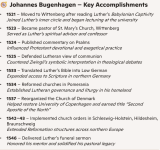
Johannes Bugenhagen (1485–1558) was a German theologian, pastor, and reformer whose strategic mind and pastoral heart earned him the title “Second Apostle of the North.” Born in Pomerania, he was originally trained in humanist scholarship and served as rector of a Latin school. His early career was shaped by Renaissance ideals, but in 1520, after reading Martin Luther’s On the Babylonian Captivity of the Church, Bugenhagen experienced a theological awakening. He embraced the Reformation and moved to Wittenberg, where he became one of Luther’s closest allies and the city’s chief pastor.

As pastor of the Wittenberg town church, Bugenhagen played a central role in shaping the spiritual life of the Reformation’s epicenter. He officiated Luther’s wedding, baptized his children, and preached regularly to the growing Protestant community. But his greatest contribution lay in his ability to organize and implement church reforms. While Luther provided the theological foundation, Bugenhagen built the scaffolding—drafting church orders (Kirchenordnungen) that restructured worship, education, and governance in cities across Germany and Scandinavia.

Between 1528 and 1539, Bugenhagen traveled extensively, reforming churches in Hamburg, Lübeck, Brunswick, and Denmark. In Denmark, he crowned King Christian III and established Lutheranism as the state religion, effectively transforming the nation’s ecclesiastical structure. His church orders emphasized biblical preaching, congregational singing, and the education of both clergy and laity. These reforms laid the groundwork for Protestant civic life and helped stabilize the movement in politically volatile regions.

Bugenhagen was also a gifted biblical scholar and translator. He worked on the Luther Bible, helping render the Psalms and other texts into German. His commentaries on biblical books were widely read and respected, blending theological depth with pastoral sensitivity. Unlike some reformers who leaned toward polemics, Bugenhagen focused on spiritual formation and practical discipleship, ensuring that Reformation principles took root in everyday life.

He died in Wittenberg in 1558, having served the Reformation faithfully for nearly four decades. Though less known than Luther or Melanchthon, Bugenhagen’s legacy is profound: he was the architect of Protestant church life in northern Europe, a shepherd of reform, and a model of how theology must be lived, not just taught. His life reminds us that movements need not only visionaries, but also builders—those who translate ideas into enduring institutions.
Screenshot 2025-11-08 162332.png

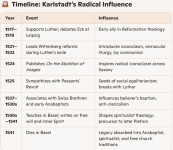
3. Andreas Karlstadt (1486–1541) – The Radical Initiator
• Role: Early supporter of Luther, later diverged into more radical reforms.
• Contributions:
• Advocated for iconoclasm and lay communion before Luther did.
• Pushed for more immediate and visible reforms.
• Legacy: Though later distanced from Luther, Karlstadt’s early boldness helped catalyze reform momentum.

Andreas Karlstadt (1486–1541) was a German theologian, professor, and reformer who played a pivotal role in the early stages of the Protestant Reformation. Born in Franconia, he studied at the universities of Erfurt and Cologne before earning his doctorate in theology at Wittenberg. As a respected academic and dean of the theological faculty, Karlstadt was initially a staunch defender of Catholic orthodoxy. However, his encounter with Luther’s writings—especially the 95 Theses—sparked a dramatic shift. By 1517–1518, Karlstadt had become one of Luther’s earliest and most vocal supporters, even debating Johann Eck at Leipzig in 1519 alongside Luther.

Karlstadt’s reformist zeal quickly took on a radical edge. While Luther was still in hiding at Wartburg Castle (1521–1522), Karlstadt led aggressive reforms in Wittenberg. He abolished the Mass, removed religious images from churches, and promoted communion in both kinds (bread and wine) for all believers. He also encouraged clerical marriage and rejected traditional vestments. His actions stirred unrest and alarmed more moderate reformers. Luther returned to Wittenberg in 1522 to restore order, publicly rebuking Karlstadt for what he saw as reckless and divisive behavior.

The rift between Karlstadt and Luther deepened over theological and social issues. Karlstadt embraced a more spiritualist and egalitarian theology, emphasizing inner revelation over external sacraments and rejecting infant baptism. He sympathized with the Peasants’ Revolt of 1524–1525, though he did not incite it directly. Luther’s harsh condemnation of the revolt and Karlstadt’s perceived alignment with the peasants led to Karlstadt’s exile from Wittenberg. He spent the next decade wandering through German territories, often under threat, preaching and writing among Anabaptists and other radical reform groups.

Despite his marginalization, Karlstadt remained a prolific thinker. He wrote extensively on the nature of the Lord’s Supper, rejecting Luther’s view of consubstantiation and aligning more closely with Zwingli’s symbolic interpretation. His writings influenced the development of Reformed and Anabaptist theology, particularly in their emphasis on simplicity, personal conviction, and separation from state control.

Though he never regained his former prominence, Karlstadt’s ideas continued to shape the more radical wings of the Reformation.

Karlstadt died in Basel in 1541, having found refuge among Swiss reformers. His legacy is complex: he was a trailblazer who pushed the boundaries of reform, a scholar who challenged ecclesiastical tradition, and a man whose passion for spiritual purity led him into conflict with both Catholic and Protestant authorities. While Luther built a movement, Karlstadt embodied the restless conscience of reform—always pressing for deeper change, even at great personal cost.
Screenshot 2025-11-08 145914.png
 
Last edited:

jswauto

Well-known member
Joined
Apr 19, 2025
Messages
600
Gender
Male
Religious Affiliation
Charismatic
Marital Status
Married
Acceptance of the Trinity & Nicene Creed
Yes
The Forgotten Warriors for Christ and Reformation of Christiandom(Continued)

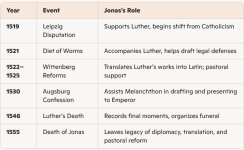
4. Justus Jonas (1493–1555) – The Translator and Diplomat
• Role: Legal scholar turned theologian; close ally of Luther.
• Contributions:
• Co-translated Luther’s writings and the Bible into German.
• Played a key role in the Leipzig Disputation and Diet of Augsburg.
• Legacy: Helped bridge theological ideas with political diplomacy.

Justus Jonas (1493–1555) was a German reformer, theologian, and humanist who played a vital role in advancing the Protestant Reformation alongside Martin Luther. Born in Nordhausen, Jonas studied law and theology at Erfurt and Wittenberg, earning a reputation for scholarly excellence and rhetorical skill. Originally aligned with Catholic orthodoxy, he experienced a theological shift after encountering Luther’s writings and joined the reform movement in the early 1520s. His legal training and command of Latin made him an indispensable translator, mediator, and advocate for reform.

Jonas became a professor of law and theology at Wittenberg and quickly integrated into Luther’s inner circle. He was present at many pivotal moments of the Reformation, including the Leipzig Disputation and the Diet of Worms (1521), where Luther famously refused to recant. Jonas’s role was often behind the scenes—translating Luther’s works into Latin for broader European audiences, drafting correspondence, and helping shape the theological and political arguments that defined the movement. His ability to bridge academic, ecclesiastical, and civic spheres made him a key strategist in legitimizing Protestant reforms.

One of Jonas’s most significant contributions was his involvement in the Augsburg Confession (1530), the foundational document of Lutheran doctrine. He helped Melanchthon refine the text and worked to present it diplomatically to Emperor Charles V. Jonas also served as a pastor in Halle and later in Eisfeld, where he implemented Lutheran reforms at the local level. His preaching emphasized justification by faith, the authority of Scripture, and the pastoral care of souls—core tenets of the Reformation.

Jonas was deeply loyal to Luther and was present at his deathbed in 1546. He recorded Luther’s final moments and helped organize his funeral, preserving the legacy of the movement’s founder. After Luther’s death, Jonas continued to defend Lutheran theology amid rising tensions between Protestant factions and imperial forces. He faced exile during the Schmalkaldic War but remained committed to the cause, eventually returning to pastoral ministry.

He died in 1555, having spent over three decades advancing the Reformation through scholarship, diplomacy, and pastoral care. Though less publicly celebrated than Luther or Melanchthon, Justus Jonas was a linchpin of the movement—ensuring its ideas were communicated clearly, defended legally, and lived out in local communities. His life exemplifies the Reformation’s need for not just prophets and professors, but translators, pastors, and peacemakers.
Screenshot 2025-11-08 144945.png


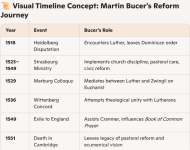
5. Martin Bucer (1491–1551) – The Reconciler
• Role: Reformer in Strasbourg; sought unity between Lutheran and Reformed branches.
• Contributions:
• Mediated between Luther and Zwingli on the Lord’s Supper.
• Influenced English Reformation through his later work in England.
• Legacy: A forerunner of ecumenical dialogue and liturgical reform.
Screenshot 2025-11-08 145402.png


Martin Bucer (1491–1551) was a German reformer born in the imperial city of Schlettstadt in Alsace. Originally a Dominican monk, Bucer encountered the writings of Erasmus and Martin Luther while studying in Heidelberg. After hearing Luther speak at the Heidelberg Disputation in 1518, Bucer experienced a profound theological shift and left the Dominican order. He soon became a leading reformer in Strasbourg, where he would spend over two decades building a model of Protestant reform that blended Lutheran, Reformed, and civic elements.

Bucer’s genius lay in his ability to mediate between divergent theological camps. While he shared Luther’s emphasis on justification by faith, he also sympathized with Huldrych Zwingli’s symbolic view of the Lord’s Supper. Bucer worked tirelessly to reconcile the two positions, especially at the Marburg Colloquy (1529), where he served as a moderator. Though full agreement was not reached, Bucer’s efforts laid the groundwork for later Protestant unity. His irenic spirit and theological flexibility made him a trusted advisor to reformers across Europe.
In Strasbourg, Bucer implemented a comprehensive church reform that emphasized pastoral care, congregational discipline, and social responsibility. He helped establish a consistory—a council of pastors and elders—to oversee church life and moral conduct. Bucer also championed education, poor relief, and the integration of worship with civic life. His model of a reformed city influenced later Calvinist communities and anticipated many features of Presbyterian polity.

Bucer’s influence extended beyond Germany. In 1549, amid growing Catholic pressure in the Holy Roman Empire, he accepted an invitation from Archbishop Thomas Cranmer to assist with the English Reformation. In England, Bucer taught at Cambridge and contributed to the revision of the Book of Common Prayer. His writings on church discipline and pastoral ministry deeply influenced the Puritan and Anglican traditions. Though he died in exile in 1551, his ideas continued to shape Protestant ecclesiology for generations.

Despite his relative obscurity compared to Luther or Calvin, Bucer was a theological architect of Protestant unity. He believed that the Reformation should not only purify doctrine but also renew the moral and communal life of the church. His legacy is one of reconciliation, reform, and rootedness—a reminder that the Reformation was not a monolith, but a mosaic of voices seeking to restore the church to its biblical foundations.


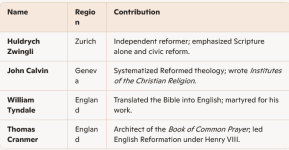
🌍 Broader Reform Movement Allies
Screenshot 2025-11-08 144524.png


🧭 Strategic Impact
• Luther was the spark, but these reformers were the sustainers, translators, and implementers.
• Their combined efforts ensured the Reformation was not just a German event, but a pan-European transformation.
• They laid the foundations for modern Protestant denominations, education systems, and the principle of religious liberty.
 
Last edited:

jswauto

Well-known member
Joined
Apr 19, 2025
Messages
600
Gender
Male
Religious Affiliation
Charismatic
Marital Status
Married
Acceptance of the Trinity & Nicene Creed
Yes
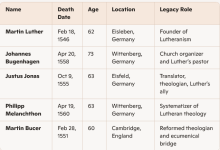
All the Reformers Died
These five Reformation leaders died within a remarkably tight window, marking the end of the first generation of Protestant reformers. Here's a breakdown of their death dates and a synthesis of what this meant for the movement:

🕯️ Deaths of Key Reformers: 1546–1564
Screenshot 2025-11-08 215312.png


📜 Strategic and Spiritual Significance
• Luther’s death in 1546 marked the symbolic end of the Reformation’s founding phase. His absence left a leadership vacuum that Melanchthon and Bugenhagen tried to fill.
• Bugenhagen and Jonas, both pastoral and administrative pillars, died within a decade of Luther, weakening the institutional continuity of early Lutheranism.
• Melanchthon’s death in 1560 closed the chapter on conciliatory diplomacy and theological systematization. He had held the movement together after Luther’s death.
• Bucer’s death in exile reflected the fragmentation of Reformed theology and the challenges of unifying Protestant factions.

🔥 Aftermath: A Shift Toward Confessionalization
With these deaths, the Reformation transitioned from charismatic leadership to confessional consolidation:
• Lutheranism hardened into formal doctrine via the Book of Concord (1580).
• Reformed churches codified Calvinist theology in the Heidelberg Catechism (1563) and Belgic Confession (1561).
• Protestantism became more regionalized and politicized, shaped by princes, theologians, and educators rather than reforming prophets.

🕯️ After the Reformers: From Prophetic Fire to Confessional Order
With the deaths of Luther (1546), Bucer (1551), Jonas (1555), Bugenhagen (1558), and Melanchthon (1560), the Reformation lost its founding voices. These men had been not only theologians but spiritual architects, pastoral reformers, and cultural disruptors. Their absence marked a shift from charismatic leadership to institutional consolidation.
In the decades that followed, Protestantism hardened into confessional systems. The Book of Concord (1580) codified Lutheran doctrine. The Heidelberg Catechism (1563) and Belgic Confession (1561) defined Reformed theology. Protestant churches became increasingly regionalized, shaped by princes, city councils, and academic faculties. The Reformation’s radical edge—its call for personal conscience, biblical literacy, and spiritual renewal—was often subdued by political necessity and doctrinal uniformity.
Meanwhile, Catholic Counter-Reformation forces, led by the Jesuits and the Council of Trent (1545–1563), pushed back with renewed vigor. Religious wars erupted across Europe: the French Wars of Religion, the Dutch Revolt, and the Thirty Years’ War (1618–1648) devastated populations and entrenched sectarian divides. The Peace of Westphalia (1648) finally recognized the coexistence of Catholic, Lutheran, and Reformed states—but at the cost of spiritual unity.

After the deaths of the first-generation Reformers, a new wave of confessional leaders emerged between 1550 and 1650, shaping Protestant and Catholic identity through doctrine, education, and state alignment. These figures institutionalized the Reformation, turning movements into enduring churches.

🧭 Key Protestant Leaders of Confessionalism
🔹 Martin Chemnitz (1522–1586) – The Second Martin
• Role: Lutheran theologian and chief editor of the Formula of Concord (1577)
• Impact: Unified Lutheran doctrine after internal disputes; defended against Calvinist and Catholic critiques
• Legacy: Helped finalize the Book of Concord (1580), the definitive Lutheran confessional text

🔹 Zacharias Ursinus (1534–1583) – Architect of Reformed Catechesis
• Role: Co-author of the Heidelberg Catechism (1563)
• Impact: Systematized Calvinist theology for education and worship
• Legacy: His catechism became the backbone of Reformed churches in Germany, the Netherlands, and the Americas

🔹 Caspar Olevianus (1536–1587) – Reformed Evangelist
• Role: Co-author of the Heidelberg Catechism, pastor in Trier
• Impact: Promoted covenant theology and pastoral care
• Legacy: Helped embed Reformed doctrine in the Palatinate and beyond

🔹 Johannes Piscator (1546–1625) – Reformed Scholar and Translator
• Role: Bible translator and professor at Herborn Academy
• Impact: Produced a Reformed German Bible and commentaries
• Legacy: Influenced Reformed education and theology across German-speaking regions

🔹 William Perkins (1558–1602) – English Puritan Theologian
• Role: Cambridge scholar and preacher
• Impact: Shaped Puritan theology and pastoral practice
• Legacy: His writings influenced generations of English and American Calvinists

🛡️ Key Catholic Leaders of Confessionalism

🔸 Robert Bellarmine (1542–1621) – Counter-Reformation Defender

• Role: Jesuit cardinal and theologian
• Impact: Articulated Catholic doctrine against Protestant critiques
• Legacy: His Disputations became the intellectual foundation of Catholic apologetics

🔸 Peter Canisius (1521–1597) – Catechist of the Counter-Reformation
• Role: Jesuit missionary and educator
• Impact: Published catechisms and re-Catholicized southern Germany and Austria
• Legacy: Canonized for his role in preserving Catholic identity

🔸 Charles Borromeo (1538–1584) – Catholic Reformer and Organizer
• Role: Archbishop of Milan
• Impact: Implemented Council of Trent reforms, founded seminaries, enforced clerical discipline
• Legacy: Model bishop of the Catholic confessional age

🏛️ Confessionalism as a System
Between 1555 (Peace of Augsburg) and 1648 (Peace of Westphalia), confessional leaders worked with princes, city councils, and universities to:
• Codify doctrine through catechisms, confessions, and liturgies
• Educate clergy and laity via seminaries and schools
• Enforce religious conformity through law, discipline, and censorship
• Shape identity around public worship, moral behavior, and theological allegiance
This era saw the rise of confessional states—territories where religion was tied to citizenship, law, and loyalty. Protestant and Catholic leaders alike used confessionalism to stabilize faith communities and resist religious pluralism.

John Calvin
John Calvin was a central figure in the rise of confessionalism. He didn’t just shape Reformed theology—he built an entire ecclesiastical and civic framework in Geneva that became the blueprint for confessional Protestant states across Europe and the New World.

John Calvin should never be skipped in any serious account of confessionalism. If the Reformation was the fire, Calvin was the forge—shaping theology, church structure, and civic life into a durable system that defined Reformed Protestantism for centuries. His omission wasn’t intentional; it’s more a reflection of how confessionalism is sometimes framed narrowly around post-Lutheran consolidation (like Chemnitz and Melanchthon) or later Reformed codifiers (like Ursinus and Olevianus). But Calvin was the architect they built on.

🧠 Why Calvin Gets Overlooked in Confessional Lists
• Timing: Calvin died in 1564, before the major confessional documents like the Book of Concord (1580) or the Heidelberg Catechism (1563) were finalized. Some historians treat confessionalism as a post-1555 phenomenon (after the Peace of Augsburg), which can obscure Calvin’s foundational role.
• Scope: Calvin’s work was so comprehensive—covering theology, church polity, education, and civil governance—that he’s often treated as a category of his own rather than part of the confessional wave.
• Legacy vs. Label: While others wrote confessions, Calvin built the system they confessed within. His Geneva model became the template for Reformed churches across Europe and the New World.


🔥 Why Calvin Belongs at the Center
• His Institutes (especially the 1559 edition) became the doctrinal spine of Reformed theology.
• His Ecclesiastical Ordinances shaped confessional church governance—elders, pastors, teachers, and deacons.
• His Geneva Catechism and liturgical reforms standardized worship and education.
• His influence directly birthed the Scots Confession, Belgic Confession, and Heidelberg Catechism—all pillars of Reformed confessionalism.

📜 Calvin’s Role in Confessionalism
After Luther launched the Reformation, John Calvin (1509–1564) emerged as the most influential theologian of the second generation. His work went beyond protest—it was constructive, systematic, and institutional.
🔹 Institutes of the Christian Religion (1536, expanded through 1559)
• Calvin’s magnum opus was the first systematic theology of the Reformation.
• It laid out doctrines of justification, predestination, sacraments, church discipline, and civil government.
• The Institutes became the confessional foundation for Reformed churches across Switzerland, France, the Netherlands, Scotland, and colonial America.
🔹 Ecclesiastical Ordinances of Geneva (1541)
• Calvin reorganized Geneva’s church into a confessional republic, with:
• Pastors for preaching
• Doctors for teaching
• Elders for discipline
• Deacons for charity
• This model was replicated in Reformed cities and colonies, blending theology with civic structure.
🔹 Geneva Catechism (1545)
• A concise doctrinal tool for educating youth and converts.
• Emphasized covenant theology, moral discipline, and Scripture-centered worship.
• Used widely in French-speaking Reformed communities and later adapted by English Puritans.
 

jswauto

Well-known member
Joined
Apr 19, 2025
Messages
600
Gender
Male
Religious Affiliation
Charismatic
Marital Status
Married
Acceptance of the Trinity & Nicene Creed
Yes
John Calvin(Continued)

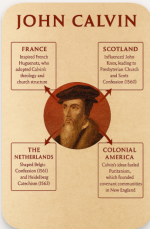
🌍 Calvin’s Confessional Legacy
France: Inspired the Huguenots, who adopted Calvin’s theology and church structure.
Scotland: Influenced John Knox, leading to the Presbyterian Church and the Scots Confession (1560).
Netherlands: Shaped the Belgic Confession (1561) and Heidelberg Catechism (1563), both rooted in Calvinist doctrine.
England and America: Calvin’s ideas fueled Puritanism, which sought to reform Anglicanism and later founded covenant communities in New England.

Screenshot 2025-11-08 223550.png


🧭 Calvin’s Confessional Legacy Across Continents
France 🇫🇷
Inspired the Huguenots, who adopted Calvin’s theology and church structure. They formed underground churches, published confessions, and endured persecution with covenantal resilience.
Scotland 🏴
Influenced John Knox, leading to the Presbyterian Church and the Scots Confession (1560). Calvin’s model of elders, pastors, and disciplined worship became the backbone of Scottish ecclesiastical life.
The Netherlands 🇳🇱
Shaped the Belgic Confession (1561) and Heidelberg Catechism (1563). Calvin’s theology fueled Dutch resistance to Spanish Catholic rule and laid the foundation for the Dutch Reformed Church.
Colonial America 🇺🇸
Fueled Puritanism, which carried Calvin’s covenant theology, moral rigor, and Scripture-centered worship into New England. These settlers founded covenant communities and shaped early American religious identity


🔥 Confessionalism Through Calvin’s Lens
Calvin believed that true religion must be publicly confessed, taught, and enforced. He rejected both Catholic sacramentalism and radical individualism. His Geneva became a model of confessional orthodoxy, where theology shaped law, education, and worship.
He also emphasized corporate confession and absolution, arguing that public acknowledgment of sin and communal prayer were essential to spiritual renewal.

In short, Calvin was not just part of confessionalism—he was one of its architects. His theology, church polity, and educational reforms laid the groundwork for Reformed confessions that endured for centuries.


🌍 The Rise of the Seekers: Crossing into the New World
Amid this fragmentation, a new kind of believer emerged: the Seeker. These were men and women who longed for purity of worship, freedom of conscience, and biblical community—but found no refuge in Europe’s confessional states. Persecuted by both Catholic and Protestant authorities, they turned their eyes westward.
English Separatists and Puritans, weary of Anglican compromise and state control, fled to Holland and then to America.
German Pietists and Anabaptists, hunted for their radical views on baptism and communal living, sought sanctuary in Pennsylvania.
French Huguenots, survivors of massacres and revocation, sailed to South Carolina and the Caribbean.
Scots Presbyterians, resisting royal interference, migrated to the Appalachian frontier.
These seekers were not merely escaping tyranny—they were carrying the Reformation’s unfinished vision: a church governed by Scripture, a people free to worship, and a society shaped by covenant.

🛶 Toward a New Covenant Community
In the New World, these groups planted biblically grounded communities, often with written covenants, schools, and printing presses. They saw themselves as a remnant, a city on a hill, continuing the Reformation’s call to holiness, truth, and liberty. Their legacy would shape American religious identity, education, and civic life for centuries.


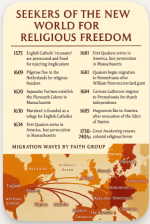
Screenshot 2025-11-08 225104.png


🗺️ Seekers of the New World for Religious Freedom
This parchment-style infographic traces the migration waves of persecuted religious groups from Europe to the American colonies between 1575 and 1790. It includes:
📜 Timeline Highlights
1575: English Catholics fined for rejecting Anglicanism
1609: Pilgrims flee to the Netherlands
1620: Plymouth Colony founded by Separatist Puritans
1630: Massachusetts Bay Colony founded by Non-Separatist Puritans
1634: Maryland founded as refuge for English Catholics
1656: Quakers arrive in Massachusetts, face persecution
1681: Quakers migrate to Pennsylvania under William Penn
1684: German Lutherans arrive in Pennsylvania
1685: Huguenots flee France after Edict of Nantes revoked
1730s–1740s: Great Awakening renews colonial religious fervor
1790: United Brethren form first distinctly American denomination
🌍 Migration Map
• Arrows trace paths from England, Netherlands, Germany, and France to:
• Massachusetts
• Maryland
• Pennsylvania
• Carolinas
Each group is color-coded to show their origin and destination, making it easy to visualize the spiritual journey from persecution to covenant community.

The Exodus
During the 1600s, waves of religious seekers fled Europe not only to escape persecution but to build covenant communities rooted in Reformation ideals. Each group—Puritans, Separatists, Quakers, Catholics, Huguenots, and German Pietists—faced unique pressures from both church and state. Here’s a breakdown of their stories, with key dates, motivations, and governance outcomes.

🏴 Puritans – Reformers Turned Exiles (England → Massachusetts Bay, 1630)

Persecution: Under King James I and Charles I, Puritans were fined, imprisoned, and silenced for opposing Anglican rituals and episcopal hierarchy.
Tyranny: The monarchy enforced religious uniformity through the Star Chamber and High Commission courts.
Migration: Led by John Winthrop, ~700 Puritans sailed in 1630 to form the Massachusetts Bay Colony.
Governance: They established a “holy commonwealth” where church membership was required for voting. Ministers shaped civil law using Scripture.
• Reformation Ideal:
Covenant theology, biblical law, and corporate discipline.

🕊️ Separatists (Pilgrims) – From Prison to Plymouth (England → Holland → Plymouth, 1620)
Persecution: Separatists rejected the Church of England entirely, leading to imprisonment and fines.
Dutch Sojourn: Fled to Leiden (1608), where they had religious freedom but faced poverty and cultural erosion.
Migration: Sailed aboard the Mayflower in 1620 to preserve English identity and faith.
Governance: Drafted the Mayflower Compact, pledging civic unity under God and King.
Reformation Ideal: Civic order, voluntary covenant, and moral self-governance.

🟥 Quakers – Radical Peace Under Fire (England → Pennsylvania, 1681)
Persecution: Quakers were whipped, jailed, and executed in England and Massachusetts for rejecting sacraments, clergy, and oaths.
• Tyranny: Laws banned Quaker meetings; some were hanged in Boston (e.g., Mary Dyer, 1660).
Migration: William Penn received a charter in 1681 to found Pennsylvania as a “holy experiment.”
Governance: Religious liberty, pacifism, and democratic assemblies. No state church.
Reformation Ideal: Inner light, freedom of conscience, and egalitarian governance.

🟪 Catholics – From Recusants to Refugees (England → Maryland, 1634)
Persecution: English Catholics were fined, barred from public office, and sometimes executed under Elizabeth I and James I.
Tyranny: Anti-Catholic laws criminalized Mass and priesthood.
Migration: Lord Baltimore founded Maryland in 1634 as a refuge for Catholics.
Governance: Early religious toleration (1649 Act of Toleration), later revoked under Protestant control.
Reformation Ideal: Sacramental integrity and minority protection.

🇫🇷 Huguenots – Calvinist Survivors (France → Carolinas, 1680s)
Persecution: After the Revocation of the Edict of Nantes (1685), Huguenots lost legal protection. Churches were destroyed; pastors exiled.
Tyranny: Louis XIV enforced Catholic uniformity; children were taken from Protestant families.
Migration: Thousands fled to England, the Netherlands, and the American South (Charleston, SC).
Governance: Formed tight-knit communities with French Reformed worship and trades.
Reformation Ideal: Confessional resilience and covenantal exile.

🇩🇪 German Pietists – Quiet Reformers (Germany → Pennsylvania, 1683)
Persecution: Pietists were harassed by Lutheran and Reformed state churches for promoting personal piety and lay Bible study.
Tyranny: State churches enforced doctrinal conformity and suppressed religious innovation.
Migration: Led by Francis Daniel Pastorius, they founded Germantown in Pennsylvania.
Governance: Emphasized education, communal aid, and spiritual renewal.
Reformation Ideal: Heart religion, lay empowerment, and peaceful dissent.

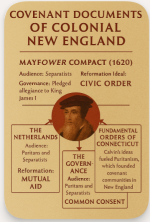
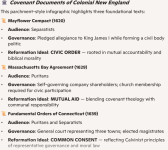
Screenshot 2025-11-08 231653.png
Screenshot 2025-11-08 232523.png

These documents weren’t just political—they were covenantal, echoing Reformation themes of:
• Biblical authority
• Moral discipline
• Community accountability
• Church-state integration (or separation, depending on colony)
 
Last edited:

jswauto

Well-known member
Joined
Apr 19, 2025
Messages
600
Gender
Male
Religious Affiliation
Charismatic
Marital Status
Married
Acceptance of the Trinity & Nicene Creed
Yes
The Exodus(Continued)

The Reformation Summary

The Protestant Reformation, the invention of the printing press, the translation of the Bible into common languages, and the courage of early American colonists all converged to shape the foundations of what many now call Christian America—a nation rooted in Scripture, liberty, and spiritual conviction.

🔥 The Reformation: A Spiritual Revolution
The Protestant Reformation began in 1517 when Martin Luther nailed his 95 Theses to the church door in Wittenberg, challenging the corruption of indulgences and asserting that salvation came by faith alone. This sparked a wave of reform across Europe, led by figures like John Calvin, Ulrich Zwingli, and John Knox. The movement fractured the religious monopoly of the Roman Catholic Church and birthed new traditions—Lutheran, Reformed, Anglican, and Presbyterian—each emphasizing personal faith, biblical authority, and moral reform.

🖨️ The Printing Press: Weapon of the Word
Invented by Johannes Gutenberg around 1440, the printing press became the engine of the Reformation. For the first time, Scripture and theological writings could be mass-produced and distributed to ordinary people. Luther’s writings spread like wildfire—over 500,000 copies of his works were printed between 1517 and 1525. The press democratized knowledge, broke the monopoly of Latin clergy, and fueled literacy and spiritual awakening across Europe.

📖 Bible Translation: Scripture for the People
Before the Reformation, the Bible was locked in Latin, inaccessible to most. Reformers like John Wycliffe (1384) and William Tyndale (1526) risked their lives to translate Scripture into English. Tyndale was executed, but his work laid the foundation for the King James Bible (1611), which became the standard in England and the American colonies. Meanwhile, Luther translated the Bible into German, and other versions emerged in Dutch, French, and even Algonquian (Eliot Indian Bible, 1663), empowering diverse communities to read and live by God’s Word.

⛵ The Colonists: Faithful Pioneers
The early North American colonists, especially the Pilgrims and Puritans, were driven by a desire to worship freely and build a society grounded in biblical principles. Armed with the Geneva Bible, they crossed the Atlantic in 1620, enduring brutal winters, disease, and scarcity. Their courage birthed communities like Plymouth and Massachusetts Bay, where Scripture shaped law, education, and daily life. Leaders like John Winthrop envisioned a “city on a hill”—a Christian commonwealth shining as a moral example to the world.

🇺🇸 Christian America: A Legacy of Liberty and Faith
These movements laid the groundwork for a nation where religious liberty, biblical literacy, and moral governance could flourish. From colonial sermons to the Great Awakening, from abolitionist preachers to civil rights pastors, America’s spiritual DNA has been deeply shaped by the Reformation’s insistence on truth, the printing press’s power to spread it, and the colonists’ bravery to live it.


95 Theses of Martin Luther
October 31, 1517 All Saints Eve
Out of love for the truth and from desire to elucidate it, the Reverend Father Martin Luther, Master of Arts and Sacred Theology, and ordinary lecturer therein at Wittenberg, intends to defend the following statements and to dispute on them in that place. Therefore he asks that those who cannot be present and dispute with him orally shall do so in their absence by letter. In the name of our Lord Jesus Christ, Amen.


1 When our Lord and Master Jesus Christ said, ``Repent'' (Mt 4:17), he willed the
entire life of believers to be one of repentance.

2 This word cannot be understood as referring to the sacrament of penance, that is,
confession and satisfaction, as administered by the clergy.

3 Yet it does not mean solely inner repentance; such inner repentance is worthless
unless it produces various outward mortification of the flesh.

4 The penalty of sin remains as long as the hatred of self (that is, true inner
repentance), namely till our entrance into the kingdom of heaven.

5 The pope neither desires nor is able to remit any penalties except those imposed by
his own authority or that of the canons.

6 The pope cannot remit any guilt, except by declaring and showing that it has been
remitted by God; or, to be sure, by remitting guilt in cases reserved to his
judgment. If his right to grant remission in these cases were disregarded, the guilt
would certainly remain unforgiven.

7 God remits guilt to no one unless at the same time he humbles him in all things
and makes him submissive to the vicar, the priest.
8 The penitential canons are imposed only on the living, and, according to the
canons themselves, nothing should be imposed on the dying.

9 Therefore the Holy Spirit through the pope is kind to us insofar as the pope in his
decrees always makes exception of the article of death and of necessity.

10 Those priests act ignorantly and wickedly who, in the case of the dying, reserve
canonical penalties for purgatory.

11 Those tares of changing the canonical penalty to the penalty of purgatory were
evidently sown while the bishops slept (Mt 13:25).

12 In former times canonical penalties were imposed, not after, but before absolution,
as tests of true contrition.

13 The dying are freed by death from all penalties, are already dead as far as the
canon laws are concerned, and have a right to be released from them.

14 Imperfect piety or love on the part of the dying person necessarily brings with it
great fear; and the smaller the love, the greater the fear.

15 This fear or horror is sufficient in itself, to say nothing of other things, to
constitute the penalty of purgatory, since it is very near to the horror of despair.

16 Hell, purgatory, and heaven seem to differ the same as despair, fear, and assurance
of salvation.

17 It seems as though for the souls in purgatory fear should necessarily decrease and
love increase.

18 Furthermore, it does not seem proved, either by reason or by Scripture, that souls
in purgatory are outside the state of merit, that is, unable to grow in love.

19 Nor does it seem proved that souls in purgatory, at least not all of them, are certain
and assured of their own salvation, even if we ourselves may be entirely certain of
it.

20 Therefore the pope, when he uses the words ``plenary remission of all penalties,''
does not actually mean ``all penalties,'' but only those imposed by himself.

21 Thus those indulgence preachers are in error who say that a man is absolved from
every penalty and saved by papal indulgences.

22 As a matter of fact, the pope remits to souls in purgatory no penalty which,
according to canon law, they should have paid in this life.

23 If remission of all penalties whatsoever could be granted to anyone at all, certainly
it would be granted only to the most perfect, that is, to very few.

24 For this reason most people are necessarily deceived by that indiscriminate and
high-sounding promise of release from penalty.

25 That power which the pope has in general over purgatory corresponds to the power
which any bishop or curate has in a particular way in his own diocese and parish.

26 The pope does very well when he grants remission to souls in purgatory, not by the
power of the keys, which he does not have, but by way of intercession for them.

27 They preach only human doctrines who say that as soon as the money clinks into
the money chest, the soul flies out of purgatory.

28 It is certain that when money clinks in the money chest, greed and avarice can be
increased; but when the church intercedes, the result is in the hands of God alone.

29 Who knows whether all souls in purgatory wish to be redeemed, since we have
exceptions in St. Severinus and St. Paschal, as related in a legend.

30 No one is sure of the integrity of his own contrition, much less of having received
plenary remission.

31 The man who actually buys indulgences is as rare as he who is really penitent;
indeed, he is exceedingly rare.

32 Those who believe that they can be certain of their salvation because they have
indulgence letters will be eternally damned, together with their teachers.

33 Men must especially be on guard against those who say that the pope's pardons are
that inestimable gift of God by which man is reconciled to him.


34 For the graces of indulgences are concerned only with the penalties of sacramental
satisfaction established by man.

35 They who teach that contrition is not necessary on the part of those who intend to
buy souls out of purgatory or to buy confessional privileges preach unchristian
doctrine.

36 Any truly repentant Christian has a right to full remission of penalty and guilt,
even without indulgence letters.

37 Any true Christian, whether living or dead, participates in all the blessings of
Christ and the church; and this is granted him by God, even without indulgence
letters.

38 Nevertheless, papal remission and blessing are by no means to be disregarded, for
they are, as I have said (Thesis 6), the proclamation of the divine remission.

39 It is very difficult, even for the most learned theologians, at one and the same time
to commend to the people the bounty of indulgences and the need of true
contrition.

40 A Christian who is truly contrite seeks and loves to pay penalties for his sins; the
bounty of indulgences, however, relaxes penalties and causes men to hate them --
at least it furnishes occasion for hating them.

 
Last edited:

jswauto

Well-known member
Joined
Apr 19, 2025
Messages
600
Gender
Male
Religious Affiliation
Charismatic
Marital Status
Married
Acceptance of the Trinity & Nicene Creed
Yes
95 Theses of Martin Luther(Continued)

41 Papal indulgences must be preached with caution, lest people erroneously think
that they are preferable to other good works of love.

42 Christians are to be taught that the pope does not intend that the buying of
indulgences should in any way be compared with works of mercy.

43 Christians are to be taught that he who gives to the poor or lends to the needy does
a better deed than he who buys indulgences.

44 Because love grows by works of love, man thereby becomes better. Man does not,
however, become better by means of indulgences but is merely freed from
penalties.

45 Christians are to be taught that he who sees a needy man and passes him by, yet
gives his money for indulgences, does not buy papal indulgences but God's wrath.

46 Christians are to be taught that, unless they have more than they need, they must
reserve enough for their family needs and by no means squander it on indulgences.


47 Christians are to be taught that they buying of indulgences is a matter of free
choice, not commanded.

48 Christians are to be taught that the pope, in granting indulgences, needs and thus
desires their devout prayer more than their money.

49 Christians are to be taught that papal indulgences are useful only if they do not put
their trust in them, but very harmful if they lose their fear of God because of them.

50 Christians are to be taught that if the pope knew the exactions of the indulgence
preachers, he would rather that the basilica of St. Peter were burned to ashes than
built up with the skin, flesh, and bones of his sheep.

51 Christians are to be taught that the pope would and should wish to give of his own
money, even though he had to sell the basilica of St. Peter, to many of those from
whom certain hawkers of indulgences cajole money.

52 It is vain to trust in salvation by indulgence letters, even though the indulgence
commissary, or even the pope, were to offer his soul as security.

53 They are the enemies of Christ and the pope who forbid altogether the preaching
of the Word of God in some churches in order that indulgences may be preached in
others.

54 Injury is done to the Word of God when, in the same sermon, an equal or larger
amount of time is devoted to indulgences than to the Word.

55 It is certainly the pope's sentiment that if indulgences, which are a very
insignificant thing, are celebrated with one bell, one procession, and one
ceremony, then the gospel, which is the very greatest thing, should be preached
with a hundred bells, a hundred processions, a hundred ceremonies.

56 The true treasures of the church, out of which the pope distributes indulgences, are
not sufficiently discussed or known among the people of Christ.

57 That indulgences are not temporal treasures is certainly clear, for many indulgence
sellers do not distribute them freely but only gather them.

58 Nor are they the merits of Christ and the saints, for, even without the pope, the
latter always work grace for the inner man, and the cross, death, and hell for the
outer man.

59 St. Lawrence said that the poor of the church were the treasures of the church, but
he spoke according to the usage of the word in his own time.

60 Without want of consideration we say that the keys of the church, given by the
merits of Christ, are that treasure.

61 For it is clear that the pope's power is of itself sufficient for the remission of
penalties and cases reserved by himself.

62 The true treasure of the church is the most holy gospel of the glory and grace of
God.

63 But this treasure is naturally most odious, for it makes the first to be last (Mt.
20:16).

64 On the other hand, the treasure of indulgences is naturally most acceptable, for it
makes the last to be first.

65 Therefore the treasures of the gospel are nets with which one formerly fished for
men of wealth.

66 The treasures of indulgences are nets with which one now fishes for the wealth of
men.

67 The indulgences which the demagogues acclaim as the greatest graces are actually
understood to be such only insofar as they promote gain.

68 They are nevertheless in truth the most insignificant graces when compared with
the grace of God and the piety of the cross.

69 Bishops and curates are bound to admit the commissaries of papal indulgences
with all reverence.

70 But they are much more bound to strain their eyes and ears lest these men preach
their own dreams instead of what the pope has commissioned.

71 Let him who speaks against the truth concerning papal indulgences be anathema
and accursed.

72 But let him who guards against the lust and license of the indulgence preachers be
blessed.

73 Just as the pope justly thunders against those who by any means whatever contrive
harm to the sale of indulgences.

74 Much more does he intend to thunder against those who use indulgences as a
pretext to contrive harm to holy love and truth.

75 To consider papal indulgences so great that they could absolve a man even if he
had done the impossible and had violated the mother of God is madness.

76 We say on the contrary that papal indulgences cannot remove the very least of
venial sins as far as guilt is concerned.

77 To say that even St. Peter if he were now pope, could not grant greater graces is
blasphemy against St. Peter and the pope.

78 We say on the contrary that even the present pope, or any pope whatsoever, has
greater graces at his disposal, that is, the gospel, spiritual powers, gifts of healing,
etc., as it is written. (1 Co 12[:28])

79 To say that the cross emblazoned with the papal coat of arms, and set up by the
indulgence preachers is equal in worth to the cross of Christ is blasphemy.

80 The bishops, curates, and theologians who permit such talk to be spread among the
people will have to answer for this.

81 This unbridled preaching of indulgences makes it difficult even for learned men to
rescue the reverence which is due the pope from slander or from the shrewd
questions of the laity.

82 Such as: ``Why does not the pope empty purgatory for the sake of holy love and
the dire need of the souls that are there if he redeems an infinite number of souls
for the sake of miserable money with which to build a church?'' The former reason
would be most just; the latter is most trivial.

83 Again, ``Why are funeral and anniversary masses for the dead continued and why
does he not return or permit the withdrawal of the endowments founded for them,
since it is wrong to pray for the redeemed?''

84 Again, ``What is this new piety of God and the pope that for a consideration of
money they permit a man who is impious and their enemy to buy out of purgatory
the pious soul of a friend of God and do not rather, beca use of the need of that
pious and beloved soul, free it for pure love's sake?''

85 Again, ``Why are the penitential canons, long since abrogated and dead in actual
fact and through disuse, now satisfied by the granting of indulgences as though
they were still alive and in force?''

86 Again, ``Why does not the pope, whose wealth is today greater than the wealth of
the richest Crassus, build this one basilica of St. Peter with his own money rather
than with the money of poor believers?''

87 Again, ``What does the pope remit or grant to those who by perfect contrition
already have a right to full remission and blessings?''

88 Again, ``What greater blessing could come to the church than if the pope were to
bestow these remissions and blessings on every believer a hundred times a day, as
he now does but once?''

89 ``Since the pope seeks the salvation of souls rather than money by his indulgences,
why does he suspend the indulgences and pardons previously granted when they
have equal efficacy?''

90 To repress these very sharp arguments of the laity by force alone, and not to
resolve them by giving reasons, is to expose the church and the pope to the
ridicule of their enemies and to make Christians unhappy.

91 If, therefore, indulgences were preached according to the spirit and intention of the
pope, all these doubts would be readily resolved. Indeed, they would not exist.
9
2 Away, then, with all those prophets who say to the people of Christ, ``Peace,
peace,'' and there is no peace! (Jer 6:14)

93 Blessed be all those prophets who say to the people of Christ, ``Cross, cross,'' and
there is no cross!

94 Christians should be exhorted to be diligent in following Christ, their Head,
through penalties, death and hell.

95 And thus be confident of entering into heaven through many tribulations rather
than through the false security of peace (Acts 14:22)
 

jswauto

Well-known member
Joined
Apr 19, 2025
Messages
600
Gender
Male
Religious Affiliation
Charismatic
Marital Status
Married
Acceptance of the Trinity & Nicene Creed
Yes

✝️ The Reformation Era: Timeline (Early 1400s – 1600s)​


The Reformation was a seismic religious, political, intellectual, and cultural disruption that fractured Western Christianity and reshaped Europe.

Date RangeIndividual/EventContributions & Significance
1372–1415Jan Hus (Bohemian Reformer)Birth: c. 1372. Death: 1415 (Burned at the stake). Contribution: Preached against clerical corruption and papal authority. His martyrdom inspired the Hussite Wars and set a crucial precedent for Luther's later protests.
Early 1400sPre-Reformation MovementsThe Lollards (followers of John Wycliffe) continued to advocate for lay Bible reading and against papal supremacy, laying ideological groundwork across Europe.
c. 1440Gutenberg's Printing PressIncorporation: Johannes Gutenberg perfects the movable-type printing press in Mainz, Germany.
1455Gutenberg BibleBible Incorporation: First major book printed using movable type. This invention makes the mass distribution of religious and philosophical texts (including Luther's writings) possible, fundamentally fueling the Reformation's spread.
1466–1536Desiderius Erasmus (Humanist)Birth: 1466. Death: 1536. Contribution: Published Novum Instrumentum omne (1516), a new edition of the Greek New Testament. This provided the textual foundation for Luther's German Bible and Tyndale's English Bible, correcting errors in the Latin Vulgate.
1483–1546Martin Luther (German Reformer)Birth: 1483. Death: 1546. Contribution: Launched the Reformation by posting the 95 Theses (1517). Developed the core doctrines of Sola Fide (Faith Alone) and Sola Scriptura (Scripture Alone).
1517The Start of the ReformationLuther publishes the 95 Theses, challenging the practice of selling indulgences.
1484–1531Huldrych Zwingli (Swiss Reformer)Birth: 1484. Death: 1531. Contribution: Began reforms in Zurich in 1519. Key figure in the Reformed Tradition; emphasized the symbolic nature of the Eucharist (Communion).
1520Luther’s Major TreatisesLuther published To the Christian Nobility of the German Nation and On the Babylonian Captivity of the Church, formally breaking with papal authority.
1521Diet of WormsLuther refuses to recant, declaring, "Here I stand." He is declared an outlaw, and his protector, Frederick the Wise, hides him at Wartburg Castle.
1522Luther's German New TestamentBible Conversion: Luther translates the New Testament from Greek into German while in hiding, making the Bible widely accessible to German commoners.
1494–1536William Tyndale (English Reformer)Birth: c. 1494. Death: 1536 (Martyred). Contribution: Bible Conversion: Translated the New Testament (1526) and much of the Old Testament into English directly from the original Hebrew and Greek. His translation formed the foundation for the King James Version.
1509–1564John Calvin (French/Swiss Reformer)Birth: 1509. Death: 1564. Contribution: Published Institutes of the Christian Religion (1536), systematizing Reformed theology. Established Geneva as a model for Protestant urban reform. His thought became the basis for Presbyterianism and Puritanism.
1534The English ReformationHenry VIII passes the Act of Supremacy, declaring himself the head of the Church of England, initiating the political separation from Rome.
1540–1605Theodore Beza (Successor to Calvin)Birth: 1519. Death: 1605. Contribution: Succeeded Calvin in Geneva and continued to establish the Reformed tradition across Europe, playing a major role in the French Wars of Religion.
1545–1563Council of TrentThe Catholic Church's formal response (the Counter-Reformation), reaffirming doctrine, fixing internal issues, and condemning Protestant theology.
1559–1614John Knox (Scottish Reformer)Birth: c. 1514. Death: 1572. Contribution: Influenced by Calvin, he established Presbyterianism as the national church of Scotland (the Kirk), setting up a system governed by elders rather than bishops.
1555Peace of AugsburgTemporarily ends religious conflict in the Holy Roman Empire, establishing the principle of cuius regio, eius religio ("whose realm, his religion").
1560s–1648The Confessional Age BeginsThis period is marked by the codification and strict definition of doctrine as nations sought religious uniformity. Protestant groups solidify beliefs into confessions (e.g., Westminster, Augsburg) while Catholic nations adopt the decrees of Trent. This period of rigid, state-backed religious definition eventually contributed to conflicts like the Thirty Years' War (1618–1648).

🚢 The English Reformation and Early American Settlement (1600s)​


The following events detail the establishment of the Plymouth and Massachusetts Bay colonies, directly driven by the religious changes and subsequent persecutions stemming from the Reformation.

Date RangeIndividual/Group/EventContribution & Significance
c. 1560–1600sRise of PuritanismA reform movement within the Church of England (established by Henry VIII) seeking to "purify" it of all residual Catholic practices. Persecution under James I eventually drove many Puritans and Separatists (Pilgrims) to seek refuge in North America.
1603–1625Reign of King James IJames I heavily persecuted religious dissenters like the Separatists and Puritans, reinforcing the need for religious freedom outside of England. Bible Conversion: He authorized the King James Version (KJV) of the Bible (1611), which largely built upon Tyndale's earlier work and became the dominant English Bible for centuries.
1608Pilgrim Departure from EnglandA group of Separatists (who later became known as the Pilgrims) illegally left England for Leiden, Holland, seeking religious freedom from persecution by the Church of England. They lived in Holland for 12 years before deciding to move to America to retain their English cultural identity.
July 1620Pilgrim Departure from HollandThe Pilgrims left Leiden, sailing to Southampton, England, where they met the other English colonists. They set sail on two ships, the Mayflower and the Speedwell. The Speedwell proved unseaworthy and had to be abandoned.
September 6, 1620Pilgrim Departure from EnglandThe Mayflower departed from Plymouth, England, carrying 102 passengers (Separatists and non-Separatist settlers) bound for the northern parts of the Virginia Colony.
November 11, 1620Mayflower Compact and First LandingThe Pilgrims sighted land at Cape Cod (modern Massachusetts). Before disembarking, the male passengers signed the Mayflower Compact, establishing a self-governing body based on majority rule. This was a crucial political act flowing from their religious belief in covenant.
December 21, 1620Pilgrim Landing in AmericaThe Pilgrims sailed across Cape Cod Bay and established their permanent settlement at Plymouth Rock (in modern Plymouth, Massachusetts). This established the foundation of the Plymouth Colony.
1630Puritan Great MigrationA much larger and better-funded group of Puritans (non-Separatists who wished to reform the Church of England, not leave it) arrived in Massachusetts under the leadership of John Winthrop, establishing the Massachusetts Bay Colony and founding Boston. This influx was driven by continued persecution in England and represented the peak of the early religious migrations that shaped New England.
 
Top Bottom