The Exodus(Continued)
The Reformation Summary
The Protestant Reformation, the invention of the printing press, the translation of the Bible into common languages, and the courage of early American colonists all converged to shape the foundations of what many now call Christian America—a nation rooted in Scripture, liberty, and spiritual conviction.
 The Reformation: A Spiritual Revolution
The Protestant Reformation began in 1517 when Martin Luther nailed his 95 Theses to the church door in Wittenberg, challenging the corruption of indulgences and asserting that salvation came by faith alone. This sparked a wave of reform across Europe, led by figures like John Calvin, Ulrich Zwingli, and John Knox. The movement fractured the religious monopoly of the Roman Catholic Church and birthed new traditions—Lutheran, Reformed, Anglican, and Presbyterian—each emphasizing personal faith, biblical authority, and moral reform.
 The Printing Press: Weapon of the Word
Invented by Johannes Gutenberg around 1440, the printing press became the engine of the Reformation. For the first time, Scripture and theological writings could be mass-produced and distributed to ordinary people. Luther’s writings spread like wildfire—over 500,000 copies of his works were printed between 1517 and 1525. The press democratized knowledge, broke the monopoly of Latin clergy, and fueled literacy and spiritual awakening across Europe.
 Bible Translation: Scripture for the People
Before the Reformation, the Bible was locked in Latin, inaccessible to most. Reformers like John Wycliffe (1384) and William Tyndale (1526) risked their lives to translate Scripture into English. Tyndale was executed, but his work laid the foundation for the King James Bible (1611), which became the standard in England and the American colonies. Meanwhile, Luther translated the Bible into German, and other versions emerged in Dutch, French, and even Algonquian (Eliot Indian Bible, 1663), empowering diverse communities to read and live by God’s Word.
 The Colonists: Faithful Pioneers
The early North American colonists, especially the Pilgrims and Puritans, were driven by a desire to worship freely and build a society grounded in biblical principles. Armed with the Geneva Bible, they crossed the Atlantic in 1620, enduring brutal winters, disease, and scarcity. Their courage birthed communities like Plymouth and Massachusetts Bay, where Scripture shaped law, education, and daily life. Leaders like John Winthrop envisioned a “city on a hill”—a Christian commonwealth shining as a moral example to the world.
 Christian America: A Legacy of Liberty and Faith
These movements laid the groundwork for a nation where religious liberty, biblical literacy, and moral governance could flourish. From colonial sermons to the Great Awakening, from abolitionist preachers to civil rights pastors, America’s spiritual DNA has been deeply shaped by the Reformation’s insistence on truth, the printing press’s power to spread it, and the colonists’ bravery to live it.
95 Theses of Martin Luther
October 31, 1517 All Saints Eve
Out of love for the truth and from desire to elucidate it, the Reverend Father Martin Luther, Master of Arts and Sacred Theology, and ordinary lecturer therein at Wittenberg, intends to defend the following statements and to dispute on them in that place. Therefore he asks that those who cannot be present and dispute with him orally shall do so in their absence by letter. In the name of our Lord Jesus Christ, Amen.
1 When our Lord and Master Jesus Christ said, ``Repent'' (Mt 4:17), he willed the
entire life of believers to be one of repentance.
2 This word cannot be understood as referring to the sacrament of penance, that is,
confession and satisfaction, as administered by the clergy.
3 Yet it does not mean solely inner repentance; such inner repentance is worthless
unless it produces various outward mortification of the flesh.
4 The penalty of sin remains as long as the hatred of self (that is, true inner
repentance), namely till our entrance into the kingdom of heaven.
5 The pope neither desires nor is able to remit any penalties except those imposed by
his own authority or that of the canons.
6 The pope cannot remit any guilt, except by declaring and showing that it has been
remitted by God; or, to be sure, by remitting guilt in cases reserved to his
judgment. If his right to grant remission in these cases were disregarded, the guilt
would certainly remain unforgiven.
7 God remits guilt to no one unless at the same time he humbles him in all things
and makes him submissive to the vicar, the priest.
8 The penitential canons are imposed only on the living, and, according to the
canons themselves, nothing should be imposed on the dying.
9 Therefore the Holy Spirit through the pope is kind to us insofar as the pope in his
decrees always makes exception of the article of death and of necessity.
10 Those priests act ignorantly and wickedly who, in the case of the dying, reserve
canonical penalties for purgatory.
11 Those tares of changing the canonical penalty to the penalty of purgatory were
evidently sown while the bishops slept (Mt 13:25).
12 In former times canonical penalties were imposed, not after, but before absolution,
as tests of true contrition.
13 The dying are freed by death from all penalties, are already dead as far as the
canon laws are concerned, and have a right to be released from them.
14 Imperfect piety or love on the part of the dying person necessarily brings with it
great fear; and the smaller the love, the greater the fear.
15 This fear or horror is sufficient in itself, to say nothing of other things, to
constitute the penalty of purgatory, since it is very near to the horror of despair.
16 Hell, purgatory, and heaven seem to differ the same as despair, fear, and assurance
of salvation.
17 It seems as though for the souls in purgatory fear should necessarily decrease and
love increase.
18 Furthermore, it does not seem proved, either by reason or by Scripture, that souls
in purgatory are outside the state of merit, that is, unable to grow in love.
19 Nor does it seem proved that souls in purgatory, at least not all of them, are certain
and assured of their own salvation, even if we ourselves may be entirely certain of
it.
20 Therefore the pope, when he uses the words ``plenary remission of all penalties,''
does not actually mean ``all penalties,'' but only those imposed by himself.
21 Thus those indulgence preachers are in error who say that a man is absolved from
every penalty and saved by papal indulgences.
22 As a matter of fact, the pope remits to souls in purgatory no penalty which,
according to canon law, they should have paid in this life.
23 If remission of all penalties whatsoever could be granted to anyone at all, certainly
it would be granted only to the most perfect, that is, to very few.
24 For this reason most people are necessarily deceived by that indiscriminate and
high-sounding promise of release from penalty.
25 That power which the pope has in general over purgatory corresponds to the power
which any bishop or curate has in a particular way in his own diocese and parish.
26 The pope does very well when he grants remission to souls in purgatory, not by the
power of the keys, which he does not have, but by way of intercession for them.
27 They preach only human doctrines who say that as soon as the money clinks into
the money chest, the soul flies out of purgatory.
28 It is certain that when money clinks in the money chest, greed and avarice can be
increased; but when the church intercedes, the result is in the hands of God alone.
29 Who knows whether all souls in purgatory wish to be redeemed, since we have
exceptions in St. Severinus and St. Paschal, as related in a legend.
30 No one is sure of the integrity of his own contrition, much less of having received
plenary remission.
31 The man who actually buys indulgences is as rare as he who is really penitent;
indeed, he is exceedingly rare.
32 Those who believe that they can be certain of their salvation because they have
indulgence letters will be eternally damned, together with their teachers.
33 Men must especially be on guard against those who say that the pope's pardons are
that inestimable gift of God by which man is reconciled to him.
34 For the graces of indulgences are concerned only with the penalties of sacramental
satisfaction established by man.
35 They who teach that contrition is not necessary on the part of those who intend to
buy souls out of purgatory or to buy confessional privileges preach unchristian
doctrine.
36 Any truly repentant Christian has a right to full remission of penalty and guilt,
even without indulgence letters.
37 Any true Christian, whether living or dead, participates in all the blessings of
Christ and the church; and this is granted him by God, even without indulgence
letters.
38 Nevertheless, papal remission and blessing are by no means to be disregarded, for
they are, as I have said (Thesis 6), the proclamation of the divine remission.
39 It is very difficult, even for the most learned theologians, at one and the same time
to commend to the people the bounty of indulgences and the need of true
contrition.
40 A Christian who is truly contrite seeks and loves to pay penalties for his sins; the
bounty of indulgences, however, relaxes penalties and causes men to hate them --
at least it furnishes occasion for hating them.


 The Event: Luther’s Bold Challenge
 The Content: What Luther Argued
 Legacy: Reformation Day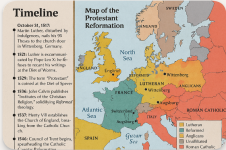
 Strategic and Spiritual Fallout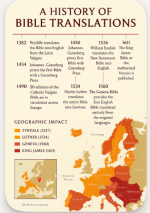
 Geographic Impact Map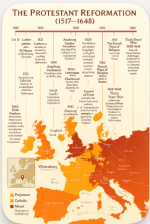
 Evangelism Through Print: Luther’s Mastery of the Medium
 Visual Evangelism: Cranach’s Role
 Impact on Christianity and Evangelism
 The Mechanics of Innovation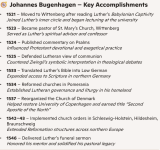
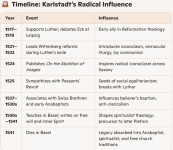
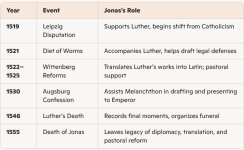
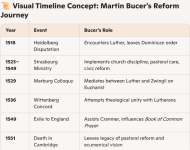
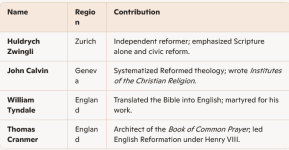
 Strategic Impact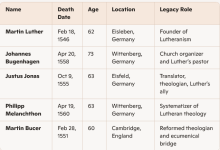
 Martin Chemnitz (1522–1586) – The Second Martin
 Key Catholic Leaders of Confessionalism
 Robert Bellarmine (1542–1621) – Counter-Reformation Defender
 Confessionalism as a System
 Why Calvin Gets Overlooked in Confessional Lists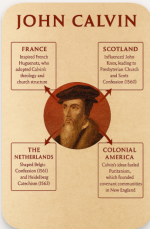


 Toward a New Covenant Community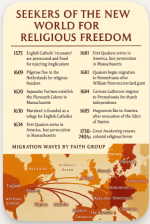
 Separatists (Pilgrims) – From Prison to Plymouth (England → Holland → Plymouth, 1620)
 Quakers – Radical Peace Under Fire (England → Pennsylvania, 1681)
 Catholics – From Recusants to Refugees (England → Maryland, 1634)
 German Pietists – Quiet Reformers (Germany → Pennsylvania, 1683)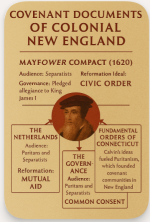
 The Reformation Era: Timeline (Early 1400s – 1600s)
 The English Reformation and Early American Settlement (1600s)