
jswauto
Well-known member
- Joined
- Apr 19, 2025
- Messages
- 991
- Gender
- Male
- Religious Affiliation
- Charismatic
- Marital Status
- Married
- Acceptance of the Trinity & Nicene Creed
- Yes
The Six Day War: Jerusalem 1967
Jerusalem 1967 — “The City in Our Hands”
In June 1967, Jerusalem once again stood at the center of history. For nineteen years, the city had been divided—its Old City, Temple Mount, and Western Wall under Jordanian control, its Jewish residents barred from their holiest sites. As regional tensions escalated and neighboring armies massed, Israel faced the possibility of annihilation. Yet within six days, the map of the Middle East would be redrawn, and Jerusalem’s story would enter a new chapter.
On June 5, the war began with a preemptive airstrike that crippled the Egyptian, Syrian, and Jordanian air forces. Jordan soon joined the conflict, shelling West Jerusalem and advancing on key positions. What began as a broader regional war quickly became, for many Israelis, a battle for the heart of their history. The hills around Jerusalem—Ammunition Hill, Government House, and other strongpoints—became scenes of intense fighting as Israeli forces pushed back Jordanian units and sought to encircle the Old City.
By June 7, the way into the Old City lay open. Israeli paratroopers advanced toward the Lion’s Gate, moving through narrow streets and ancient walls that had witnessed centuries of conflict and longing. When they broke through and reached the Temple Mount, a radio message went out that would echo through generations: “Har HaBayit beYadeinu”—“The Temple Mount is in our hands.” Soldiers who had grown up hearing of the Western Wall only in stories now stood before its stones, some weeping, some praying, some simply leaning their heads against the ancient blocks in silence.
For many, this moment carried a weight far beyond military victory. It was seen as a turning point in the long arc of Jewish history—a return to the Old City after nearly two thousand years of dispersion and foreign rule. Scriptures about Jerusalem, long read as distant promises or future hopes, suddenly felt immediate and alive. Psalm 122’s call to “pray for the peace of Jerusalem,” Luke 21:24’s reference to Jerusalem and the times of the Gentiles, and Zechariah’s visions of a burdensome stone among the nations all seemed to converge in a single week of history.
Yet the capture of Jerusalem was not framed only as triumph. Israeli leaders quickly declared that holy sites of all faiths would be protected and that access would be granted to Jews, Christians, and Muslims alike. The city, long contested and often scarred by conquest, was to be treated as a trust rather than a trophy. In this tension—between victory and responsibility, restoration and restraint—Jerusalem 1967 stands as both a military event and a spiritual signpost, a moment when history, prophecy, and human decision intertwined on ancient stones.
1. High‑level frame of the 1967 war
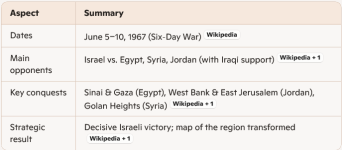
2. Chronological layout — day‑by‑day
June 5 — Preemptive strike and Sinai shock
• Morning: Israel launches Operation Focus—a surprise airstrike that destroys most of Egypt’s air force on the ground within hours, and cripples Syrian and Jordanian air power soon after.
• This “air decapitation” gives Israel near‑total air superiority, shaping the entire war. Many believers later point to the timing, precision, and the Egyptian “don’t fire on incoming planes” order as a providential opening.
June 6–7 — Sinai, West Bank, and Jerusalem
• Sinai: Israeli armor and infantry push rapidly through Egyptian lines, capturing key positions and causing large‑scale Egyptian retreat toward the Suez Canal.
• West Bank: After Jordan joins the war, Israel counterattacks, capturing strategic points around Jerusalem and in the central ridge of the West Bank.
• June 7 (28 Iyar on Hebrew calendar): Israeli paratroopers break into the Old City of Jerusalem via the Lion’s Gate; the Temple Mount and Western Wall come under Jewish control for the first time in nearly 2,000 years.
June 8–10 — Gaza, Sinai completion, and Golan Heights
• Gaza & Sinai: Israeli forces complete the capture of Gaza and reach the Suez Canal, effectively removing Egypt’s army from the fight in Sinai.
• Golan Heights (June 9–10): Israel assaults the heavily fortified Syrian positions on the Golan Heights, capturing the plateau and removing a long‑standing artillery threat over northern Israel.
• June 10: Ceasefire; the war ends after six days.
3. Scriptural and prophetic overlays often connected
Believers and teachers frequently connect the 1967 war—especially the reunification of Jerusalem—with passages such as:
• Jerusalem and the nations:
• Zechariah 12:2–3 — Jerusalem as a “cup of trembling” and “burdensome stone” among the nations.
• Luke 21:24 — “Jerusalem shall be trodden down of the Gentiles, until the times of the Gentiles be fulfilled.”
• Return and restoration themes:
• Ezekiel 36–37 — restoration of Israel to the land and spiritual renewal.
• Psalm 102:13–16 — the Lord arising to have mercy on Zion, “for the time to favor her… has come,” and “when the Lord shall build up Zion, He shall appear in His glory.”
Different streams interpret these connections differently, but many see 1967 and the return of Jewish control over the Old City as a significant marker in the long arc of Jerusalem’s prophetic story.
4. Reported miracles and providential turns
From within Israeli and Christian circles, the Six‑Day War is often described as a cascade of “impossible” turns:
• The air campaign: The Egyptian order not to fire on incoming planes during Allenby‑style inspection flights left their airfields exposed at the exact moment Israel struck—allowing hundreds of planes to be destroyed with minimal Israeli losses.
• Outnumbered yet victorious: Israel faced numerically superior Arab forces in men, tanks, and aircraft, yet achieved a rapid, decisive victory in six days.
• Jerusalem’s Old City: The fact that the Old City fell so quickly, with relatively limited urban destruction, is often viewed as a mercy—given how easily it could have become a prolonged, devastating battle.
Many testimonies (soldiers’ memoirs, sermons, and later compilations) speak of:
• units spared from ambushes,
• enemy forces retreating in confusion,
• “coincidental” weather, timing, or miscommunications that favored Israel.
These are interpreted by many as the hidden hand of God preserving and advancing Israel in a moment of existential danger.
5. Heroes and key actions
A few of the most noted figures and actions:
• Moshe Dayan (Defense Minister) and Yitzhak Rabin (IDF Chief of Staff) — strategic leadership of the overall campaign.
• Uzi Narkiss — commanded the Central Command that captured East Jerusalem and the West Bank.
• Paratroopers at Jerusalem — the units that fought at Ammunition Hill, entered the Old City, and reached the Western Wall; their radio call “Har HaBayit beYadeinu” (“The Temple Mount is in our hands”) became iconic.
• Armored commanders in Sinai and on the Golan — leading daring maneuvers through difficult terrain and fortified lines.
From a spiritual‑chronicle lens, the “heroes” are both:
• the visible commanders and soldiers, and
• the unseen faithfulness of God, preserving a small nation surrounded by hostile armies.
6. Ways many see the Lord’s blessing on Israel in 1967
From a faith‑reading of history, the Lord’s blessing is often traced in:
• Preservation from annihilation: Israel faced rhetoric of destruction and encirclement by multiple armies; instead, the war ended in six days with Israel still standing and strengthened.
• Regaining Jerusalem’s Old City: For many, Jewish access to the Western Wall and Temple Mount after centuries is seen as a profound act of restoration.
• Strategic depth and security: The capture of Sinai, Golan, and the central ridge of the West Bank gave Israel buffers against future attacks, seen by many as providential protection.
• Global awakening: 1967 stirred worldwide interest in Israel, prophecy, and Jerusalem, catalyzing prayer movements and theological reflection on God’s purposes for Israel and the nations.
Jerusalem 1967 — “The City in Our Hands”
In June 1967, Jerusalem once again stood at the center of history. For nineteen years, the city had been divided—its Old City, Temple Mount, and Western Wall under Jordanian control, its Jewish residents barred from their holiest sites. As regional tensions escalated and neighboring armies massed, Israel faced the possibility of annihilation. Yet within six days, the map of the Middle East would be redrawn, and Jerusalem’s story would enter a new chapter.
On June 5, the war began with a preemptive airstrike that crippled the Egyptian, Syrian, and Jordanian air forces. Jordan soon joined the conflict, shelling West Jerusalem and advancing on key positions. What began as a broader regional war quickly became, for many Israelis, a battle for the heart of their history. The hills around Jerusalem—Ammunition Hill, Government House, and other strongpoints—became scenes of intense fighting as Israeli forces pushed back Jordanian units and sought to encircle the Old City.
By June 7, the way into the Old City lay open. Israeli paratroopers advanced toward the Lion’s Gate, moving through narrow streets and ancient walls that had witnessed centuries of conflict and longing. When they broke through and reached the Temple Mount, a radio message went out that would echo through generations: “Har HaBayit beYadeinu”—“The Temple Mount is in our hands.” Soldiers who had grown up hearing of the Western Wall only in stories now stood before its stones, some weeping, some praying, some simply leaning their heads against the ancient blocks in silence.
For many, this moment carried a weight far beyond military victory. It was seen as a turning point in the long arc of Jewish history—a return to the Old City after nearly two thousand years of dispersion and foreign rule. Scriptures about Jerusalem, long read as distant promises or future hopes, suddenly felt immediate and alive. Psalm 122’s call to “pray for the peace of Jerusalem,” Luke 21:24’s reference to Jerusalem and the times of the Gentiles, and Zechariah’s visions of a burdensome stone among the nations all seemed to converge in a single week of history.
Yet the capture of Jerusalem was not framed only as triumph. Israeli leaders quickly declared that holy sites of all faiths would be protected and that access would be granted to Jews, Christians, and Muslims alike. The city, long contested and often scarred by conquest, was to be treated as a trust rather than a trophy. In this tension—between victory and responsibility, restoration and restraint—Jerusalem 1967 stands as both a military event and a spiritual signpost, a moment when history, prophecy, and human decision intertwined on ancient stones.
1. High‑level frame of the 1967 war
2. Chronological layout — day‑by‑day
June 5 — Preemptive strike and Sinai shock
• Morning: Israel launches Operation Focus—a surprise airstrike that destroys most of Egypt’s air force on the ground within hours, and cripples Syrian and Jordanian air power soon after.
• This “air decapitation” gives Israel near‑total air superiority, shaping the entire war. Many believers later point to the timing, precision, and the Egyptian “don’t fire on incoming planes” order as a providential opening.
June 6–7 — Sinai, West Bank, and Jerusalem
• Sinai: Israeli armor and infantry push rapidly through Egyptian lines, capturing key positions and causing large‑scale Egyptian retreat toward the Suez Canal.
• West Bank: After Jordan joins the war, Israel counterattacks, capturing strategic points around Jerusalem and in the central ridge of the West Bank.
• June 7 (28 Iyar on Hebrew calendar): Israeli paratroopers break into the Old City of Jerusalem via the Lion’s Gate; the Temple Mount and Western Wall come under Jewish control for the first time in nearly 2,000 years.
June 8–10 — Gaza, Sinai completion, and Golan Heights
• Gaza & Sinai: Israeli forces complete the capture of Gaza and reach the Suez Canal, effectively removing Egypt’s army from the fight in Sinai.
• Golan Heights (June 9–10): Israel assaults the heavily fortified Syrian positions on the Golan Heights, capturing the plateau and removing a long‑standing artillery threat over northern Israel.
• June 10: Ceasefire; the war ends after six days.
3. Scriptural and prophetic overlays often connected
Believers and teachers frequently connect the 1967 war—especially the reunification of Jerusalem—with passages such as:
• Jerusalem and the nations:
• Zechariah 12:2–3 — Jerusalem as a “cup of trembling” and “burdensome stone” among the nations.
• Luke 21:24 — “Jerusalem shall be trodden down of the Gentiles, until the times of the Gentiles be fulfilled.”
• Return and restoration themes:
• Ezekiel 36–37 — restoration of Israel to the land and spiritual renewal.
• Psalm 102:13–16 — the Lord arising to have mercy on Zion, “for the time to favor her… has come,” and “when the Lord shall build up Zion, He shall appear in His glory.”
Different streams interpret these connections differently, but many see 1967 and the return of Jewish control over the Old City as a significant marker in the long arc of Jerusalem’s prophetic story.
4. Reported miracles and providential turns
From within Israeli and Christian circles, the Six‑Day War is often described as a cascade of “impossible” turns:
• The air campaign: The Egyptian order not to fire on incoming planes during Allenby‑style inspection flights left their airfields exposed at the exact moment Israel struck—allowing hundreds of planes to be destroyed with minimal Israeli losses.
• Outnumbered yet victorious: Israel faced numerically superior Arab forces in men, tanks, and aircraft, yet achieved a rapid, decisive victory in six days.
• Jerusalem’s Old City: The fact that the Old City fell so quickly, with relatively limited urban destruction, is often viewed as a mercy—given how easily it could have become a prolonged, devastating battle.
Many testimonies (soldiers’ memoirs, sermons, and later compilations) speak of:
• units spared from ambushes,
• enemy forces retreating in confusion,
• “coincidental” weather, timing, or miscommunications that favored Israel.
These are interpreted by many as the hidden hand of God preserving and advancing Israel in a moment of existential danger.
5. Heroes and key actions
A few of the most noted figures and actions:
• Moshe Dayan (Defense Minister) and Yitzhak Rabin (IDF Chief of Staff) — strategic leadership of the overall campaign.
• Uzi Narkiss — commanded the Central Command that captured East Jerusalem and the West Bank.
• Paratroopers at Jerusalem — the units that fought at Ammunition Hill, entered the Old City, and reached the Western Wall; their radio call “Har HaBayit beYadeinu” (“The Temple Mount is in our hands”) became iconic.
• Armored commanders in Sinai and on the Golan — leading daring maneuvers through difficult terrain and fortified lines.
From a spiritual‑chronicle lens, the “heroes” are both:
• the visible commanders and soldiers, and
• the unseen faithfulness of God, preserving a small nation surrounded by hostile armies.
6. Ways many see the Lord’s blessing on Israel in 1967
From a faith‑reading of history, the Lord’s blessing is often traced in:
• Preservation from annihilation: Israel faced rhetoric of destruction and encirclement by multiple armies; instead, the war ended in six days with Israel still standing and strengthened.
• Regaining Jerusalem’s Old City: For many, Jewish access to the Western Wall and Temple Mount after centuries is seen as a profound act of restoration.
• Strategic depth and security: The capture of Sinai, Golan, and the central ridge of the West Bank gave Israel buffers against future attacks, seen by many as providential protection.
• Global awakening: 1967 stirred worldwide interest in Israel, prophecy, and Jerusalem, catalyzing prayer movements and theological reflection on God’s purposes for Israel and the nations.
Last edited:


 Additional Modern Events of Note