 Was There a Warmer Period When the Vikings Came to Greenland?
 Yes — multiple studies show the Vikings arrived during a warm spell.
Search results directly confirm this:
 1. Northwestern University Study (2019): Vikings enjoyed a warm Greenland
A detailed climate reconstruction found that southern Greenland was relatively warm between 985 and 1450 CE, the exact period of Norse settlement.
• The study shows Vikings “enjoyed a warm Greenland” when they arrived.
• Summers may have reached 50°F, similar to modern temperatures.
• This warm period was unlike the centuries before or after.
This supports the long‑held idea that the Norse settled Greenland during a climatically favorable window.
2. Atlas Obscura Summary of the Same Research
Another source confirms the same finding:
• Vikings “got lucky and hit Greenland during a warm spell”.
• The warm period made farming and grazing possible.
• Cooling and climate instability later contributed to the collapse of their colonies.
3. Earth Magazine Study: A Contrasting View
One study suggests that Greenland may not have warmed as much as Europe during the Medieval Warm Period:
• Glacial evidence shows Greenland “remained cold enough” for glaciers to advance between 925–1275 CE.
• This implies the Medieval Warm Period was stronger in Europe than in Greenland.
But this study focuses on glacier extent, not summer temperatures or local microclimates.
 How to Reconcile These Studies
The simplest synthesis:

Southern Greenland — where the Vikings lived — was warmer than usual
Supported by sediment‑core temperature reconstructions.
Some parts of Greenland remained cold
Supported by glacial moraine evidence.
The Medieval Warm Period was real, but uneven
Europe warmed more dramatically than Greenland, but southern Greenland still experienced a mild, farm‑friendly climate.
 Why This Matters for Viking Settlement
The warm spell allowed:
• Pasture for cattle, sheep, and goats
• Barley cultivation in some areas
• Open seas for travel
• More stable winters
When the climate cooled again (1300s–1400s), the Norse colonies collapsed.
How many Norse lived in Greenland at its peak?
Search results give a firm number:
• 2,000–3,000 people total in all of Greenland at peak population.
This is the entire Norse population of Greenland — men, women, children, farmers, clergy, hunters.
 How many of them went to North America?
Not many.
Only small exploration crews traveled to North America.
Evidence:
• L’Anse aux Meadows was a short‑term camp, not a colony.
• It lacked graves, livestock areas, and permanent structures.
• It was abandoned by 1145 AD with no valuables left behind.
• No other Norse settlements in Canada or the U.S. have been found.
Expeditions were small
The sagas and archaeology suggest:
• 20–80 people per voyage, not hundreds.
• These were seasonal crews, not settlers.
• They came for timber, iron, and exploration — not colonization.
No permanent Norse migration into Canada or the U.S.
Why didn’t more migrate?
• Greenland had no population pressure — only 2,000–3,000 people.
• The warm period made Greenland livable, not overcrowded.
• The Little Ice Age later made survival harder, but by then:
• Trade collapsed
• The Black Death devastated Norway
• The Norse lacked ships and manpower to migrate outward
What happened to the Greenland Norse?
• They died out in Greenland
• Or returned to Europe (more likely because valuables were taken)
There is no evidence that they migrated to North America in large numbers
 Origins of Nordic Immigrants in Minnesota, Wisconsin, and Michigan
The Nordic (Scandinavian) settlers who shaped the Upper Midwest came primarily from three countries:
 1. Sweden — the largest group
Sweden sent more immigrants to the U.S. than any other Nordic country between 1821–1920.
• Over 1.1 million Swedes immigrated to the U.S. in that period.
• Many settled in Minnesota, which became the most Swedish state in America.
• Michigan and Wisconsin also received large Swedish farming and lumber communities.
 2. Norway — the second‑largest group
The Library of Congress notes that Norway sent nearly 1 million immigrants to the U.S. between 1820–1920.
• Wisconsin was an early center of Norwegian settlement.
• By 1850, two‑thirds of all Norwegians in the U.S. lived in Wisconsin.
• Later waves moved into Minnesota and the Dakotas.
Norwegians were especially drawn to:
• farming land
• Lutheran communities
• familiar climate and terrain
 3. Denmark — a smaller but significant group
Denmark contributed 300,000 immigrants to the U.S. between 1821–1920.
• Many Danes settled in Wisconsin, Minnesota, and Michigan, especially in farming and dairy regions.
• Danish Lutherans established churches and folk schools across the Midwest.
Why the Upper Midwest?
The search results highlight several reasons:
• Fertile farmland similar to Scandinavia
• Lutheran communities already established
• Chain migration (letters home encouraging others to come)
• Homestead Act opportunities (especially for Norwegians)
Origin of Denmark’s Claim on Greenland
 1. Norse Settlement & Allegiance to the Norwegian Crown
According to the Danish Institute for International Studies:
• The Norse settled southern Greenland during the Viking Age.
• These settlers pledged allegiance to the Norwegian king.
• This placed Greenland under the Norwegian realm, not Denmark, at first.
This is the earliest political link between Scandinavia and Greenland.
 2. The Denmark–Norway Union (1380–1814)
When Denmark and Norway entered a political union, their territories merged.
• During this union, Greenland became part of the joint Danish‑Norwegian kingdom.
• Even after the Norse colonies disappeared, the territory remained attached to Norway — and therefore to the union.
This is where Denmark’s later claim begins to take shape.
 3. Post‑Napoleonic Wars: Greenland Follows Denmark
When the union dissolved in 1814:
• Norway was ceded to Sweden.
• Greenland, Iceland, and the Faroe Islands remained with Denmark.
This was the decisive moment that made Greenland a Danish possession.
4. Danish Re‑Colonization (1721 onward)
Another source notes:
• Denmark’s modern claim began in 1721, when missionary Hans Egede established a permanent Danish‑Norwegian presence in Greenland.
• Denmark then tightened control and restricted foreign access.
This reinforced sovereignty through continuous occupation.
 5. U.S. Recognition of Danish Sovereignty (1917)
As part of the treaty transferring the U.S. Virgin Islands:
• The United States formally recognized Denmark’s sovereignty over all of Greenland.
This gave Denmark international backing.
 6. International Court Ruling (1933)
Norway attempted to claim part of East Greenland.
• The International Court in The Hague ruled in Denmark’s favor.
This legally cemented Denmark’s claim under international law.


 Strategic Advantages for the U.S. if It Controlled Greenland
 1.
1.  2.
2.  3.
3.  4.
4.  6.
6.  8.
8. 

 ICELAND — Why a “cold” name for a relatively green land?
 1. Early Norse explorers saw ice—but also green valleys
 3. Icelanders named their own land
 GREENLAND — Why a “green” name for a frozen continent?
 2. Southern Greenland was greener then
 3. The name was partly marketing
 4. Greenland is mostly ice today
 SUMMARY OF NAMES TABLE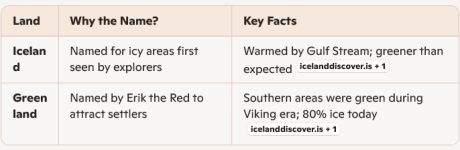
 1. Total Regional Size & Habitability
 Finland