
CrossWalk
Active member
- Joined
- Mar 8, 2025
- Messages
- 26
- Gender
- Male
- Religious Affiliation
- Christian
- Acceptance of the Trinity & Nicene Creed
- No
I have studied the Bible for about 15 years now on my own. The understanding I've come to based on pure Scripture is one that I can only align with Covenant Theology, Post-Tribulation Rapture and Amillennialism. If those terms mean nothing to you, you're not alone.
The vast majority of churches today don't teach these terms or their meanings but they do teach a much different system of Dispensationalism, Pre-Tribulation Rapture, Premillennialism. Those who take the time to read the Bible on their own, prayerfully and with a sincere heart, will never come away with any understanding of the modern mainstream foundation of doctrines called Dispensationalism. It is not taught in the Bible at all.
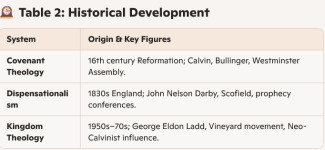
On the contrary, Dispensationalism contradicts Scripture from beginning to end. If you're a churchgoing Christian, you have likely been steeped in the Dispensational teachings and never had a clue that there were any other interpretations of Scripture to study and choose from. Dispensationalism did not arrive on the scene until the 1800's. Prior to that, all of the church held a Covenant Theology position. Here are some of the main differences between the two interpretations.
1. View of History
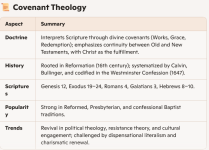
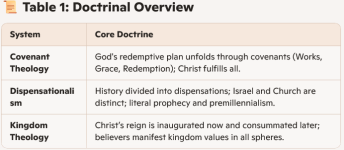
Dispensationalism: Sees history divided into distinct “dispensations” (periods) where God deals with humanity in different ways.
Covenant Theology: Sees history as one continuous unfolding of God’s covenant of grace, centered on redemption through Christ.
2. Israel and the Church
Dispensationalism: Israel and the Church are distinct (two 'separate' brides); God has separate plans for each.
Covenant Theology: The Church (all those who embrace Jesus Christ [Gal. 3:16,26,29]) is the continuation or fulfillment of Israel; one people of God (one bride).
3. Interpretation of Scripture
Dispensationalism: Emphasizes a literal interpretation (though not consistently), especially of prophecy.
Covenant Theology: Uses a more symbolic or typological approach, seeing Old Testament promises fulfilled spiritually in Christ.
4. Eschatology (End Times)
Dispensationalism: Usually premillennial—expects a future literal kingdom for Israel.
Covenant Theology: Often amillennial or postmillennial—sees the kingdom as present spiritually in the Church - Christ reigning 'now' in and through all those who love and embrace Him, who carry His Spirit.
5. Central Theme
Dispensationalism: God’s glory through different administrations.
Covenant Theology: God’s redemption of His people through covenantal relationship.
Conclusion:
Dispensationalism is a 100% man-made doctrine that does not align with the Bible at all.
Feel free to discuss and pose questions or Biblically-grounded challenges.
God bless.
The vast majority of churches today don't teach these terms or their meanings but they do teach a much different system of Dispensationalism, Pre-Tribulation Rapture, Premillennialism. Those who take the time to read the Bible on their own, prayerfully and with a sincere heart, will never come away with any understanding of the modern mainstream foundation of doctrines called Dispensationalism. It is not taught in the Bible at all.
On the contrary, Dispensationalism contradicts Scripture from beginning to end. If you're a churchgoing Christian, you have likely been steeped in the Dispensational teachings and never had a clue that there were any other interpretations of Scripture to study and choose from. Dispensationalism did not arrive on the scene until the 1800's. Prior to that, all of the church held a Covenant Theology position. Here are some of the main differences between the two interpretations.
1. View of History
Dispensationalism: Sees history divided into distinct “dispensations” (periods) where God deals with humanity in different ways.
Covenant Theology: Sees history as one continuous unfolding of God’s covenant of grace, centered on redemption through Christ.
2. Israel and the Church
Dispensationalism: Israel and the Church are distinct (two 'separate' brides); God has separate plans for each.
Covenant Theology: The Church (all those who embrace Jesus Christ [Gal. 3:16,26,29]) is the continuation or fulfillment of Israel; one people of God (one bride).
3. Interpretation of Scripture
Dispensationalism: Emphasizes a literal interpretation (though not consistently), especially of prophecy.
Covenant Theology: Uses a more symbolic or typological approach, seeing Old Testament promises fulfilled spiritually in Christ.
4. Eschatology (End Times)
Dispensationalism: Usually premillennial—expects a future literal kingdom for Israel.
Covenant Theology: Often amillennial or postmillennial—sees the kingdom as present spiritually in the Church - Christ reigning 'now' in and through all those who love and embrace Him, who carry His Spirit.
5. Central Theme
Dispensationalism: God’s glory through different administrations.
Covenant Theology: God’s redemption of His people through covenantal relationship.
Conclusion:
Dispensationalism is a 100% man-made doctrine that does not align with the Bible at all.
Feel free to discuss and pose questions or Biblically-grounded challenges.
God bless.
Last edited:
 Core Tenets of Dispensationalism
 Historical Development
 Comparison to Covenant Theology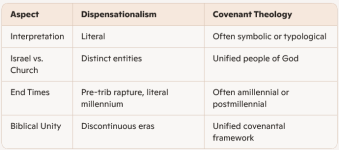
 Implications
 Origins and Early Development (1830s–1870s)
 Codification and Popularization (1870s–1920s)
 Political and Cultural Impact (1920s–1970s)
 Internal Evolution and Decline (1980s–Present)
 Core Covenants
 Strategic Implications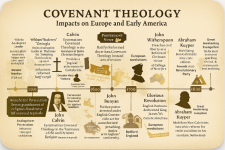
 Reformation and Systematization (16th Century)
 Opposition and Decline (18th–19th Century)
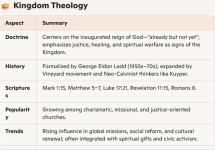
 What Is Kingdom Theology?
 Impact
 Global Expansion and Political Impact (1980s–Present)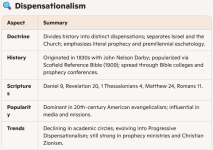
 Evangelical and Fundamentalist Denominations (Dispensationalism)
 Liturgical and Sacramental Traditions (Hybrid or Covenant-Based)