• Welcome to Christianity Haven, thank you for visiting! If you have not already, we invite you to create an account and join in on the many discussions we have! 

    • Please be aware that when registering you must not register while using a VPN. Any registrations made using a VPN will be rejected.
    • Additionally, registration emails are not being sent out which is an issue that is being worked on. Your registration may go into an approval queue for admin approval. We work to send manual emails to the email on file, so please ensure the email you use is one you can readily access! 

What is Dispensationalism and is it Biblical?

CrossWalk

Active member
Joined
Mar 8, 2025
Messages
26
Gender
Male
Religious Affiliation
Christian
Acceptance of the Trinity & Nicene Creed
No
I have studied the Bible for about 15 years now on my own. The understanding I've come to based on pure Scripture is one that I can only align with Covenant Theology, Post-Tribulation Rapture and Amillennialism. If those terms mean nothing to you, you're not alone.

The vast majority of churches today don't teach these terms or their meanings but they do teach a much different system of Dispensationalism, Pre-Tribulation Rapture, Premillennialism. Those who take the time to read the Bible on their own, prayerfully and with a sincere heart, will never come away with any understanding of the modern mainstream foundation of doctrines called Dispensationalism. It is not taught in the Bible at all.

On the contrary, Dispensationalism contradicts Scripture from beginning to end. If you're a churchgoing Christian, you have likely been steeped in the Dispensational teachings and never had a clue that there were any other interpretations of Scripture to study and choose from. Dispensationalism did not arrive on the scene until the 1800's. Prior to that, all of the church held a Covenant Theology position. Here are some of the main differences between the two interpretations.

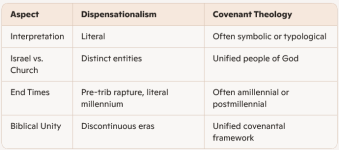
1. View of History

Dispensationalism:
Sees history divided into distinct “dispensations” (periods) where God deals with humanity in different ways.
Covenant Theology: Sees history as one continuous unfolding of God’s covenant of grace, centered on redemption through Christ.

2. Israel and the Church

Dispensationalism:
Israel and the Church are distinct (two 'separate' brides); God has separate plans for each.
Covenant Theology: The Church (all those who embrace Jesus Christ [Gal. 3:16,26,29]) is the continuation or fulfillment of Israel; one people of God (one bride).

3. Interpretation of Scripture

Dispensationalism:
Emphasizes a literal interpretation (though not consistently), especially of prophecy.
Covenant Theology: Uses a more symbolic or typological approach, seeing Old Testament promises fulfilled spiritually in Christ.

4. Eschatology (End Times)

Dispensationalism:
Usually premillennial—expects a future literal kingdom for Israel.
Covenant Theology: Often amillennial or postmillennial—sees the kingdom as present spiritually in the Church - Christ reigning 'now' in and through all those who love and embrace Him, who carry His Spirit.

5. Central Theme

Dispensationalism:
God’s glory through different administrations.
Covenant Theology: God’s redemption of His people through covenantal relationship.

Conclusion:

Dispensationalism is a 100% man-made doctrine that does not align with the Bible at all.

Feel free to discuss and pose questions or Biblically-grounded challenges.

God bless.
 
Last edited:

Maranatha

Well-known member
Joined
Sep 6, 2025
Messages
64
Gender
Male
Religious Affiliation
Christian
Acceptance of the Trinity & Nicene Creed
No
Dispensationalism is a 100% man-made doctrine that does not align with the Bible at all.
The Church (all those who embrace Jesus Christ [Gal. 3:16,26,29]) is the continuation or fulfillment of Israel; one people of God.

I totally agree with those statements .
It is no longer about Jew or Greek or Gentile.
It is now all about Christ and the Gospel and His Church, His Bride
 

Frankj

Well-known member
Joined
Nov 11, 2024
Messages
923
Gender
Male
Religious Affiliation
Non-Denominational
Acceptance of the Trinity & Nicene Creed
Yes
Covenant Theology: Often amillennial or postmillennial—sees the kingdom as present spiritually in the Church - Christ reigning 'now' in and through all those who love and embrace Him, who carry His Spirit.

I've heard this before and am mostly neutral toward it, but it seems that if this is truth it should be evident in the world around us, the world we live in.

Could you show some examples of this taking place in the world as we live our daily lives in it as Christians.
 

CrossWalk

Active member
Joined
Mar 8, 2025
Messages
26
Gender
Male
Religious Affiliation
Christian
Acceptance of the Trinity & Nicene Creed
No
I totally agree with those statements .
It is no longer about Jew or Greek or Gentile.
It is now all about Christ and the Gospel and His Church, His Bride
Amen, @Maranatha.

I have discovered that all of Biblical study and analysis can primarily be simplified down to two simple questions.

1. Who/what is the Bible about, Christ (God) or Israel?

2. Who is Israel?

I believe the most honest reading of Scripture reveals that the entire Bible is about Jesus Christ (God) and Israel is defined in the Bible as those who embrace Him (Christ/God).

The Bible clearly states that if you don't have Christ, you don't have God (the Father). There is no way 'to' God (the Father) without going through, or by way of, Christ. The 'Christ'-ian Faith must contain Christ. Any version of it that does not, is not the Christian Faith and is anti-Christian.

Dispensationalism comes shy of being anti-Christian, but it defies and alters these major points in one way or another. In that sense it could be argued that it is anti-Bible. You cannot come to the conclusions that this doctrine teaches while remaining in true alignment with Scripture.

God bless.
 

CrossWalk

Active member
Joined
Mar 8, 2025
Messages
26
Gender
Male
Religious Affiliation
Christian
Acceptance of the Trinity & Nicene Creed
No
Hi @Frankj. Well, Jesus Himself actually denied that common challenge to the concept of His Kingdom needing to be physical and visible. He said multiple times, I believe, that His Kingdom is not of this world and He also said that it is here now and exists within those who believe and embrace Him.

I find Scripture to carry more weight than any physical scenario I might point out or try and relate to defend the concept of Kingdom-Now theology. Happy to discuss further though if you would like verses or have any other questions about it.

One interesting dynamic that is very real in Christendom is that you can have a Spirit-filled believer who embraces Christ in discussion with a professed Christian who has been involved in churches many years and is just as certain of their position and have both convinced that their position is correct and in alignment with the Faith, but the only real way to discern which is correct is through Scripture. USUALLY one of them is less willing to go to the Bible to settle the matter than the other.

The one who stands on the Bible and has learned from God's Word over man's teachings will hold the advantage, but the other will usually never admit being wrong no matter how much Scripture is presented to support the opposing position. I only mention this scenario because I've witnessed it so many times, online and in person.

God bless.
 

jswauto

Well-known member
Joined
Apr 19, 2025
Messages
600
Gender
Male
Religious Affiliation
Charismatic
Marital Status
Married
Acceptance of the Trinity & Nicene Creed
Yes
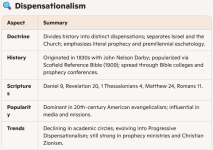
Dispensationalism in a Nutshell

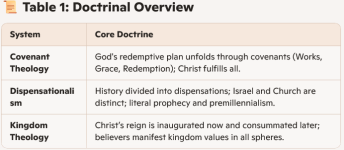
Dispensationalism is a theological system that divides history into distinct periods (or “dispensations”) in which God interacts with humanity in different ways, emphasizing a literal interpretation of Scripture and a clear distinction between Israel and the Church.
Here’s a structured breakdown of its key features, origins, and implications:

📜 Core Tenets of Dispensationalism

1. Literal Interpretation of Scripture

• Dispensationalists interpret biblical prophecy and promises—especially those concerning Israel and the End Times—literally.
• For example, the “1,000 years” in Revelation 20 is seen as a literal future reign of Christ on earth.

2. Distinct Peoples of God
• Israel and the Church are viewed as separate entities with distinct roles in God’s plan.
• The Church does not replace Israel; promises made to ethnic Israel are expected to be fulfilled in the future.

3. Seven Dispensations (Classical View)
• History is divided into seven eras, each marked by a specific way God relates to humanity:
1. Innocence (Adam before the Fall)
2. Conscience (Post-Fall to the Flood)
3. Human Government (Post-Flood to Babel)
4. Promise (Abraham to Moses)
5. Law (Moses to Christ)
6. Grace (Church Age)
7. Kingdom (Millennial Reign of Christ)
• Each dispensation involves a test, human failure, and divine judgment.

4. Premillennial Eschatology
• Dispensationalists typically believe in a pre-tribulation rapture of the Church, followed by a literal seven-year tribulation, and then a millennial reign of Christ on earth.

5. Unfulfilled Prophecies for Israel
• Old Testament promises to Israel (land, kingdom, blessing) are expected to be fulfilled in the future, not spiritually transferred to the Church.

🧠 Historical Development
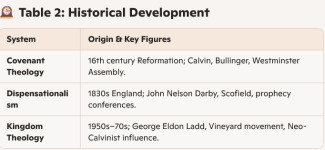
• John Nelson Darby (19th century) is considered the father of Dispensationalism.
• Popularized through the Scofield Reference Bible and taught widely at Dallas Theological Seminary.
• Evolved into Classic, Revised, and Progressive Dispensationalism, with varying views on the relationship between Israel and the Church.

🔍 Comparison to Covenant Theology
1762400584127.png


🧭 Implications

• Shapes views on prophecy, politics (especially support for modern Israel), and evangelism.
• Influences popular End Times literature (e.g., Left Behind series).
• Criticized for over-segmenting Scripture and promoting escapist eschatology.

Dispensationalism emerged in the 19th century as a radical reorganization of biblical interpretation, emphasizing distinct eras of God’s dealings with humanity, a sharp separation between Israel and the Church, and a literalist, futurist eschatology. It reshaped evangelical theology, influenced global missions, and impacted political attitudes toward Israel and global affairs.


📜 Full Historical Breakdown of Dispensationalism

🧱 Origins and Early Development (1830s–1870s)

  • Founder: John Nelson Darby, an Irish Anglican priest turned leader of the Exclusive Brethren, developed dispensationalism in the 1830s.
  • Where: Ireland and England, later spreading to North America.
  • Core Idea: Darby taught that history is divided into distinct “dispensations” or administrations of God’s plan. He emphasized a futurist interpretation of prophecy, a pretribulational rapture, and a literal restoration of Israel.
  • Why It Emerged: Reaction against liberal theology, ecclesiastical corruption, and postmillennial optimism. Darby sought a biblical system that preserved doctrinal purity and eschatological urgency.

📖 Codification and Popularization (1870s–1920s)
  • Key Tool: Scofield Reference Bible (1909), edited by Cyrus I. Scofield, embedded dispensational notes into Scripture, making the system accessible to lay readers.
  • Centers of Influence: Seminaries in Dallas, Winona Lake, and Los Angeles became hubs of dispensational teaching.
  • Evangelists: D.L. Moody, Lewis Sperry Chafer, and others promoted dispensational themes in revival preaching and missions.
  • Church Reaction:

  • Fundamentalists: Embraced dispensationalism as a bulwark against modernism.
  • Mainline Protestants: Rejected it as speculative and divisive.
  • Reformed theologians: Criticized its novelty and theological fragmentation.

⚔️ Political and Cultural Impact (1920s–1970s)
  • Zionism and Israel: Dispensationalism’s emphasis on Israel’s prophetic role led many evangelicals to support Jewish restoration and later the state of Israel (1948).
  • Cold War Theology: Dispensationalists interpreted global events (e.g., rise of communism, Middle East conflicts) as signs of the end times.
  • Christian Zionism: Figures like Hal Lindsey (The Late Great Planet Earth, 1970) popularized dispensational eschatology, linking biblical prophecy to geopolitical developments.
  • Criticism: Theological opponents accused dispensationalism of escapism, undermining social reform, and promoting fear-based religion.
🔄 Internal Evolution and Decline (1980s–Present)
  • Revised Dispensationalism: Softened rigid distinctions between Israel and the Church; emphasized continuity in God’s plan.
  • Progressive Dispensationalism: Emerged in the 1990s (e.g., Darrell Bock, Craig Blaising), integrating kingdom theology and allowing partial fulfillment of promises in the Church.
  • Decline: Many seminaries and churches shifted toward covenantal or kingdom frameworks. Dispensationalism lost dominance but remains influential in evangelical media and prophecy ministries.
🧭 Strategic Legacy
  • Accepted By: Many Baptist, Pentecostal, and independent evangelical churches.
  • Enduring Themes: Literal prophecy, rapture theology, support for Israel, and urgency in missions.
  • Opposition: Reformed, Lutheran, and Anglican traditions continue to critique its theological and historical foundations.
 
Last edited:

jswauto

Well-known member
Joined
Apr 19, 2025
Messages
600
Gender
Male
Religious Affiliation
Charismatic
Marital Status
Married
Acceptance of the Trinity & Nicene Creed
Yes
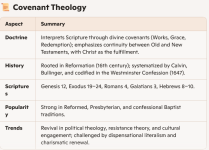
📜 Covenant Theology: A Unified Framework of Redemption
Covenant Theology is a theological system that interprets the Bible through the lens of divine covenants—binding agreements initiated by God to reveal His character, establish relationship, and unfold His redemptive plan. It sees Scripture not as a fragmented timeline, but as a cohesive narrative centered on Christ and His covenantal work.
🔗 Core Covenants
Covenant of Works: Established with Adam, promising life for obedience and death for disobedience. It sets the stage for humanity’s need for redemption.
Covenant of Grace: Initiated after the Fall, this covenant unfolds progressively through Abraham, Moses, David, and ultimately Christ, offering salvation by grace through faith.
Covenant of Redemption: An eternal agreement within the Godhead, where the Father sends the Son to redeem a people, and the Spirit applies that redemption.
📖 Hermeneutic Approach
• Scripture is interpreted as a unified story of God's covenantal dealings with His people.
• Typology and fulfillment are key: Old Testament figures, events, and institutions point forward to Christ.
• The Church is seen as the continuation of God’s covenant people, inheriting promises through union with Christ.
🛡️ Strategic Implications
• Emphasizes continuity of moral law and ethical responsibility across eras.
• Grounds spiritual endurance in covenantal identity, not geopolitical shifts.
• Provides a framework for cultural engagement, restoration, and resistance rooted in divine promises and obligations.

📜 Historical Development of Covenant Theology
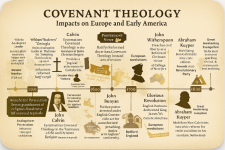
🧱 Foundations in the Early Church (4th–5th Century)

• Key Figure: Augustine of Hippo (354–430 AD) laid the groundwork by articulating the Covenant of Works (with Adam) and the Covenant of Grace (fulfilled in Christ) in The City of God.
Why It Mattered: Augustine’s framework emphasized humanity’s federal representation in Adam and Christ, shaping later Reformed soteriology.
Church Reaction: The early church accepted covenantal ideas in a latent form, but they remained underdeveloped through the medieval period.
Screenshot 2025-11-09 102221.png


🔥 Reformation and Systematization (16th Century)
Where: Switzerland, Germany, and later England and Scotland.
Who:
Heinrich Bullinger (Zurich, 1504–1575): First to articulate a formal covenantal framework in his Decades and De Testamento.
John Calvin (Geneva): Emphasized covenant continuity and grace, though less systematized than later theologians.
Why: Reformers sought to replace the medieval sacramental system with a biblical, grace-centered theology. Covenant theology offered a unifying structure for Scripture and salvation.
Church Reaction: Enthusiastically embraced by Reformed churches; encoded in confessions like the Westminster Confession of Faith (1647), which called covenant theology the “architectonic principle” of Reformed doctrine.

⚔️ Political Ramifications and Resistance Theory (17th Century)
Where: England, Scotland, and Colonial America.
Who:
Samuel Rutherford (Scotland): In Lex, Rex (1644), used covenant theology to argue against the divine right of kings.
Puritans and Covenanters: Applied covenant theology to justify resistance to tyranny and promote godly governance.
Why: Covenant theology undergirded political covenants like the Solemn League and Covenant (1643), asserting that rulers were bound by divine law and accountable to the people.
Impact: Influenced early American political thought, including the Mayflower Compact and later the U.S. Constitution via social contract theory.

⚖️ Opposition and Decline (18th–19th Century)
Opposition:
• Lutherans and Arminians rejected covenant theology’s emphasis on predestination and federal headship.
• Dispensationalism (19th century, John Nelson Darby) arose as a rival system, emphasizing discontinuity and literalism.
Decline: Enlightenment rationalism and revivalist movements shifted focus away from covenantal frameworks toward individual experience and eschatological speculation.

🧭 Strategic Legacy
• Accepted By: Reformed, Presbyterian, and many Baptist traditions.
• Enduring Influence: Shapes Christian views on law, grace, family, education, and political resistance.
• Modern Resurgence: Renewed interest in covenant theology as a bulwark against secularism and theological fragmentation.
 
Last edited:

jswauto

Well-known member
Joined
Apr 19, 2025
Messages
600
Gender
Male
Religious Affiliation
Charismatic
Marital Status
Married
Acceptance of the Trinity & Nicene Creed
Yes
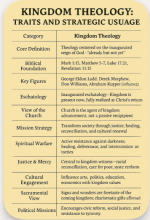
👑 What Is Kingdom Theology?

Kingdom Theology
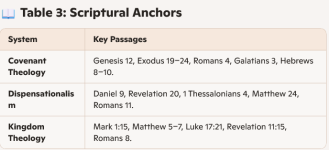
is a system of Christian thought that centers on the inaugurated reign of God—the idea that the Kingdom of God began with Jesus’ first coming and will be consummated at His return. It emphasizes living in the tension between the “already” and the “not yet.”

📖 Key Features
  • Inaugurated Eschatology: The Kingdom is present now in part, but will be fully realized in the future.
  • Mission and Justice: Believers are called to manifest kingdom values—justice, mercy, healing, reconciliation—in every sphere of life.
  • Spiritual Warfare: Recognizes ongoing conflict between the Kingdom of God and the kingdom of darkness.
  • Signs and Wonders: Healing, prophecy, and miracles are seen as present-day manifestations of the Kingdom.
🧠 Leading Voices
  • George Eldon Ladd: Systematized Kingdom Theology in the mid-20th century, emphasizing the overlap of “This Age” and “The Age to Come.”
  • Derek Morphew and Don Williams: Vineyard theologians who expanded the framework to include charismatic gifts and justice.
  • Abraham Kuyper (Neo-Calvinist): Though not a kingdom theologian per se, his “every square inch” doctrine influenced cultural engagement within Kingdom Theology.
🏛️ Impact
  • Church Mission: Shifts focus from escape to transformation—believers are agents of renewal.
  • Cultural Engagement: Encourages Christians to influence politics, education, economics, and the arts with kingdom values.
  • Global Missions: Fuels evangelism and humanitarian work as expressions of God’s reign.

Kingdom Theology formally emerged in the mid-20th century through George Eldon Ladd, but its roots stretch back to early Christianity’s expectation of Christ’s reign. It developed as a response to dispensationalism’s pessimism and covenant theology’s institutionalism, offering a dynamic, missional vision of God's rule.

📜 Historical Development of Kingdom Theology

Screenshot 2025-11-09 165044.png


🧱 Early Christian Foundations (1st–4th Century)

Expectation of the Kingdom: Early Christians believed Jesus inaugurated the Kingdom of God through His life, death, and resurrection. This hope shaped their resistance to Roman imperial cults and refusal to participate in state-sanctioned violence.
Church-State Tension: Christians saw themselves as citizens of a heavenly kingdom, often clashing with Roman authority. Their allegiance to Christ as King undermined emperor worship and led to persecution.

🏛️ Medieval and Reformation Periods (5th–17th Century)

Spiritualization of the Kingdom: As Christianity became institutionalized, the Kingdom was increasingly interpreted as a spiritual reality within the Church.
Calvin’s Two Kingdoms Doctrine: John Calvin distinguished between the spiritual kingdom (Church) and the civil kingdom (State), laying groundwork for later political theology.
Abraham Kuyper (1837–1920): Though not a Kingdom theologian per se, Kuyper’s Neo-Calvinism emphasized Christ’s lordship over all spheres of life—“every square inch”—and inspired cultural engagement and civic reform.

🔥 Formal Emergence (1940s–1970s)

George Eldon Ladd: A New Testament scholar at Fuller Theological Seminary, Ladd systematized inaugurated eschatology—the idea that the Kingdom is both present and future. His work countered dispensationalism’s escapism and emphasized mission, justice, and spiritual warfare.
Key Works: The Gospel of the Kingdom (1959), The Presence of the Future (1974).
Church Reaction:
Evangelicals: Welcomed Ladd’s framework as a biblical alternative to dispensationalism.
Charismatics: Integrated Kingdom Theology with signs, wonders, and healing.
Mainline Protestants: Adopted its justice-oriented themes for social reform.

🌍 Global Expansion and Political Impact (1980s–Present)
Missional Movements: Kingdom Theology fueled global missions, humanitarian work, and justice initiatives. It inspired movements like Lausanne, Vineyard, and World Vision.
Political Theology: Encouraged civic engagement, resistance to tyranny, and advocacy for the marginalized. It shaped Christian responses to apartheid, poverty, and injustice.
Critiques:
• Some Reformed theologians argue Kingdom Theology blurs lines between Church and State.
• Others fear it overemphasizes social action at the expense of doctrinal clarity.

🧭 Strategic Legacy

Influence: Charismatic churches, justice coalitions, and missional networks.
Usage: Mobilizes believers for cultural renewal, spiritual resistance, and holistic mission.
Contrast: Rejects dispensational escapism and covenantal institutionalism in favor of active kingdom advancement.
 
Last edited:

jswauto

Well-known member
Joined
Apr 19, 2025
Messages
600
Gender
Male
Religious Affiliation
Charismatic
Marital Status
Married
Acceptance of the Trinity & Nicene Creed
Yes
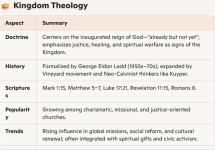
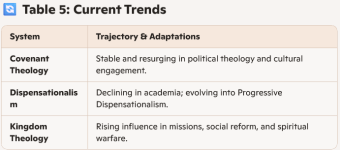
Let'sCompare the Three

Screenshot 2025-11-09 194011.png


Screenshot 2025-11-09 194119.png


Screenshot 2025-11-09 194239.png


Today's Trends
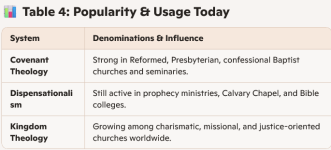
Today, Kingdom Theology is gaining momentum among missional, charismatic, and justice-oriented churches, while Covenant Theology remains strong in Reformed traditions. Dispensationalism, once dominant in American evangelicalism, is declining in academic circles but still influential in prophecy ministries and popular media.

Covenant Theology
In the current theological landscape, Covenant Theology continues to thrive within Reformed, Presbyterian, and confessional Baptist circles. It remains the backbone of institutions like Westminster Seminary and denominations such as the PCA and OPC. Its emphasis on continuity, confessional depth, and covenantal identity appeals to churches seeking doctrinal stability and historical rootedness. Covenant Theology is also experiencing a quiet resurgence among younger theologians who value its resistance to theological novelty and its robust framework for cultural engagement and political theology. Its influence is especially strong in academic theology, classical Christian education, and ecclesiastical reform movements.

Dispensationalism
Dispensationalism, once the dominant system in 20th-century American evangelicalism, is now undergoing a transformation. Classic dispensationalism—marked by rigid Israel-Church separation and pretribulational rapture—has lost ground in seminaries and scholarly circles. However, Progressive Dispensationalism, led by figures like Darrell Bock and Craig Blaising, has softened some of its sharp distinctions and remains active in institutions like Dallas Theological Seminary. Despite its academic decline, dispensationalism still holds sway in prophecy ministries, Christian Zionist networks, and popular media. Churches influenced by Calvary Chapel, prophecy conferences, and end-times literature continue to propagate its framework, especially in regions where geopolitical events are interpreted through a biblical lens.

Kingdom Theology
Meanwhile, Kingdom Theology is rapidly ascending as a preferred framework among charismatic, missional, and justice-driven churches. Formalized by George Eldon Ladd in the mid-20th century, it emphasizes the “already/not yet” nature of Christ’s reign and calls believers to manifest kingdom values—justice, healing, reconciliation—in every sphere of life. Movements like Vineyard, Lausanne, and World Vision have adopted Kingdom Theology as a mobilizing force for global missions and social renewal. Its appeal lies in its balance: it affirms spiritual gifts, engages culture, and resists both escapism and institutional rigidity. As younger generations seek holistic discipleship and societal impact, Kingdom Theology offers a compelling alternative to older paradigms.

Summary
In terms of popularity, Kingdom Theology is surging, especially in non-denominational and charismatic contexts. Covenant Theology holds steady among confessional churches and academic institutions. Dispensationalism, while still visible, is increasingly marginalized in scholarly theology and is often critiqued for its fragmentation and geopolitical entanglements. The trend suggests a shift from systems that emphasize separation and prediction toward those that emphasize integration, mission, and transformation.

Screenshot 2025-11-09 200436.png

Screenshot 2025-11-09 200516.png


Screenshot 2025-11-09 200613.png

Screenshot 2025-11-09 200653.png

Screenshot 2025-11-09 200729.png

Most modern Christian denominations align with one of three theological systems—Covenant Theology, Dispensationalism, or Kingdom Theology—based on their historical roots, doctrinal priorities, and missional focus. Reformed churches favor Covenant Theology for its confessional depth, evangelical groups often retain Dispensationalism for its prophetic clarity, and charismatic/missional movements embrace Kingdom Theology for its transformative vision.

🏛️ Reformed and Confessional Denominations (Covenant Theology)
Who: Presbyterian Church in America (PCA), Orthodox Presbyterian Church (OPC), Reformed Baptist, United Reformed Churches, Anglican Church in North America (ACNA).
What They Use: Covenant Theology.
Why:
• Emphasizes continuity between Old and New Testaments.
• Grounds doctrine in historic confessions (Westminster, Heidelberg).
• Supports sacramental theology, Sabbath observance, and civic resistance.
• Strategic Focus: Doctrinal fidelity, ecclesiastical order, and cultural engagement rooted in divine law.

🔮 Evangelical and Fundamentalist Denominations (Dispensationalism)
Who: Independent Baptist, Calvary Chapel, Assemblies of God (some), Bible churches, Dallas Theological Seminary alumni networks.
What They Use: Dispensationalism (classic or progressive).
Why:
• Offers a literalist framework for prophecy and end-times.
• Distinguishes Israel from the Church, supporting Christian Zionism.
• Appeals to lay readers via Scofield Bible and prophecy media.
• Strategic Focus: Evangelism, urgency, and geopolitical awareness.

🌍 Charismatic, Missional, and Justice-Oriented Churches (Kingdom Theology)
Who: Vineyard, Bethel, Newfrontiers, World Vision, Lausanne Movement, many non-denominational churches.
What They Use: Kingdom Theology.
Why:
• Emphasizes the present reign of Christ and spiritual warfare.
• Mobilizes believers for justice, healing, and cultural renewal.
• Integrates charismatic gifts with civic activism.
• Strategic Focus: Holistic mission, societal transformation, and grassroots mobilization.

🕊️ Liturgical and Sacramental Traditions (Hybrid or Covenant-Based)
Who: Roman Catholic, Eastern Orthodox, Lutheran (LCMS, ELCA), Methodist (UMC, Global Methodist).
What They Use: Covenant Theology (modified), Sacramental frameworks, or Two Kingdoms doctrine.
Why:
• Rooted in apostolic tradition and sacramental continuity.
• Emphasizes church-state distinction and moral formation.
• Some Lutherans use Two Kingdoms to balance civic and spiritual authority.
• Strategic Focus: Worship, tradition, and ethical formation.

📈 Trends and Shifts
Covenant Theology: Stable and resurging among younger Reformed thinkers.
Dispensationalism: Declining in academia; evolving into progressive forms.
Kingdom Theology: Rapidly expanding in global missions, justice movements, and charismatic networks.
 
Last edited:
Top Bottom