• Welcome to Christianity Haven, thank you for visiting! If you have not already, we invite you to create an account and join in on the many discussions we have! 

    • Please be aware that when registering you must not register while using a VPN. Any registrations made using a VPN will be rejected.
    • Additionally, registration emails are not being sent out which is an issue that is being worked on. Your registration may go into an approval queue for admin approval. We work to send manual emails to the email on file, so please ensure the email you use is one you can readily access! 

what do you think of christian universalism?:)

jesus lover

Well-known member
Joined
May 14, 2025
Messages
223
Gender
Male
Religious Affiliation
Methodist
Marital Status
Single
Acceptance of the Trinity & Nicene Creed
Yes
What do you think of christian universalism? :)
 

Lamb

God's Lil Lamb
Community Team
Administrator
Supporting Member
Joined
Jun 10, 2015
Messages
34,540
Age
59
Gender
Female
Religious Affiliation
Lutheran
Political Affiliation
Conservative
Marital Status
Married
Acceptance of the Trinity & Nicene Creed
Yes
Define what you mean by the term?
 

Frankj

Well-known member
Joined
Nov 11, 2024
Messages
936
Gender
Male
Religious Affiliation
Non-Denominational
Acceptance of the Trinity & Nicene Creed
Yes
Unsound doctrine.

Basically all roads lead to heaven, but that is not what Jesus taught when he taught of the wide and the narrow ones.

The last Pope seemed to think this way and the current one maybe also as well as a number of Christian denominations and New Age pseudo Christian movements.

I suppose it depends on what you believe about Biblical truth and whether or not you believe the Bible actually says what it means and means what it says as to whether you accept this as a true or false doctrine, but consider that the latter days are to be days of deceit according to prophecy.
 

Can't think of a name

Well-known member
Joined
Aug 12, 2025
Messages
213
Gender
Male
Religious Affiliation
Christian
Marital Status
Single
Acceptance of the Trinity & Nicene Creed
Yes
What do you think of christian universalism? :)

There's a verse in Timothy that says "Christ is the saviour of all men. Even to those who believe". I think this COULD be taken in two senses. 1) Christ is the propitiation for all men but not all men will accept him. and 2) This denotes universal salvation for all people at the end of time.

It is because of verses like this that there are so many different groups of Christianity. And woe to you if you hold an exclusive interpretation that others consider to be heretical! It shouldn't really be that way though. And yes people will fight tooth and nail and to the death even over their cherished interpretation or belief. That's because beliefs are strong things and in the wrong hands they can become fanatical. Let's stop to consider that the Bible contains many passages like this one and that it is not a problem with the texts themselves but that they are often contradictory in such a way that leaves them open to different interpretations to different people. These aren't contradictions per se but subtle differences that can lead to people coming away from them with dogmatic views. It's hard to bring out of such texts just one view that is the only correct one.

People will say that if everybody goes to heaven in the end that hell isn't eternal either and thus a great portion of the Bible appears to be contradicted. But usually you will find that those that are staunch in their views about this matter are more interested and involved in eschatological points of view. They have a fear based approach. They concentrate so much on the book of Revelation to the detriment of what is meant by the "Kingdom of God" that they don't even seem to realise that Revelation is part of the literary genre of apocalyptic literature which contain so much symbolism it is almost impossible to derive any literal understandings from the text (although some of that is mixed in). They are petrified of going to hell or of their friends and family going to hell that instead of concentrating on God they are more focused on the afterlife. But the presence of God now is the same thing as heaven, not so much in location but in conscious awareness. All of that is to not say that hell doesn't exist in some way. Certainly if the soul or spirit exists and is present in the physical body right now while we are alive then it stands to reason it has to go somewhere when the physical body dies. And that might be a bad place or a good place. It's helpful to keep hell in mind during this life we have so that when we die we end up in a good place. But overemphasis on hell is not good. I didn't get bamboozled into outright terror of hell when I came to God and God saved me because my priority was not that God could save me from hell but rather that I wanted to be with God for God's sake alone. Otherwise it would have constituted a bribe and the Bible says God doesn't accept a bribe.

One factor in favour of the idea of a universal salvation is that humans are made in the image of God. That means that God would have to send a part of Himself to hell when he sent people to hell and that view is ludicrous. My own view is that I don't know what the complete picture is but if we can allow the Bible to speak for itself and not force our own views on the text, there are possibilities that leave room for different views. In other words, I don't know. But I do know this - humans are stubborn creatures and it is due to bigotry, pride and anger that they feel it is justified to murder other people who hold a different view - and that that type of behaviour belongs to the dark ages and ought not to exist today.
 

CrossWalk

Active member
Joined
Mar 8, 2025
Messages
26
Gender
Male
Religious Affiliation
Christian
Acceptance of the Trinity & Nicene Creed
No
There's a verse in Timothy that says "Christ is the saviour of all men. Even to those who believe". I think this COULD be taken in two senses. 1) Christ is the propitiation for all men but not all men will accept him. and 2) This denotes universal salvation for all people at the end of time.

It is because of verses like this that there are so many different groups of Christianity. And woe to you if you hold an exclusive interpretation that others consider to be heretical! It shouldn't really be that way though. And yes people will fight tooth and nail and to the death even over their cherished interpretation or belief. That's because beliefs are strong things and in the wrong hands they can become fanatical. Let's stop to consider that the Bible contains many passages like this one and that it is not a problem with the texts themselves but that they are often contradictory in such a way that leaves them open to different interpretations to different people. These aren't contradictions per se but subtle differences that can lead to people coming away from them with dogmatic views. It's hard to bring out of such texts just one view that is the only correct one.

People will say that if everybody goes to heaven in the end that hell isn't eternal either and thus a great portion of the Bible appears to be contradicted. But usually you will find that those that are staunch in their views about this matter are more interested and involved in eschatological points of view. They have a fear based approach. They concentrate so much on the book of Revelation to the detriment of what is meant by the "Kingdom of God" that they don't even seem to realise that Revelation is part of the literary genre of apocalyptic literature which contain so much symbolism it is almost impossible to derive any literal understandings from the text (although some of that is mixed in). They are petrified of going to hell or of their friends and family going to hell that instead of concentrating on God they are more focused on the afterlife. But the presence of God now is the same thing as heaven, not so much in location but in conscious awareness. All of that is to not say that hell doesn't exist in some way. Certainly if the soul or spirit exists and is present in the physical body right now while we are alive then it stands to reason it has to go somewhere when the physical body dies. And that might be a bad place or a good place. It's helpful to keep hell in mind during this life we have so that when we die we end up in a good place. But overemphasis on hell is not good. I didn't get bamboozled into outright terror of hell when I came to God and God saved me because my priority was not that God could save me from hell but rather that I wanted to be with God for God's sake alone. Otherwise it would have constituted a bribe and the Bible says God doesn't accept a bribe.

One factor in favour of the idea of a universal salvation is that humans are made in the image of God. That means that God would have to send a part of Himself to hell when he sent people to hell and that view is ludicrous. My own view is that I don't know what the complete picture is but if we can allow the Bible to speak for itself and not force our own views on the text, there are possibilities that leave room for different views. In other words, I don't know. But I do know this - humans are stubborn creatures and it is due to bigotry, pride and anger that they feel it is justified to murder other people who hold a different view - and that that type of behaviour belongs to the dark ages and ought not to exist today.
I think you touched on a very important point concerning 'cherry-picking' verses and creating doctrines around them. The Bible is not a collection of detached verses like so many who are insincere make it out to be. It is a book. It is the mind of God. It was 'written' by God, believe that or not. It is His opinions and His proclamations and His expectations for His people, etc.

To answer the OP's question, the term Christian Universalism is an oxymoron. Those words fundamentally contradict each other. There is nothing universal about a Faith that is fundamentally exclusive. Many would be offended by, or strongly disagree with, that, but it's very easy to prove. Does the Christian Faith that is based on the Bible itself allow anyone to believe or act in any way they like and still claim that they will all go to heaven? If that were the case, there would be no need at all for the Bible, or it would be a very small pamphlet at minimum.

Modern churches are businesses. Exclusivity is a very poor business model, thus, churches must be as 'inclusive' ("Come one, come all!") as they can be or they will not make any money. The Faith itself, on the other hand, is very 'exclusive' as it 'excludes' those who worship other gods, who believe and act as they wish, etc. Therefore, there is no possibility of Christianity being "Universal". It is only those who embrace Jesus Christ and His "Way" that will be saved and go to heaven. There just simply is no modern rendition of that concept that God will accept.

God bless.
 

jswauto

Well-known member
Joined
Apr 19, 2025
Messages
601
Gender
Male
Religious Affiliation
Charismatic
Marital Status
Married
Acceptance of the Trinity & Nicene Creed
Yes
⚠️ Criticisms of Christian Universalism

📖 1. Undermines Biblical Warnings of Judgment
• Many passages speak of eternal punishment, separation, and wrath (e.g., Matthew 25:46, Revelation 20:15).
• Critics argue Universalism reinterprets or dismisses these warnings, weakening the gravity of sin and divine justice.

🧠 2. Dilutes Human Responsibility and Free Will
• If all are saved regardless of choices, it may:
• Undermine moral accountability.
• Suggest that repentance and faith are optional rather than essential.
• Reduce the urgency of personal transformation.

🛐 3. Weakens Evangelistic Urgency
• Traditional missions are driven by the belief that salvation is not guaranteed.
• Universalism may reduce the perceived need to preach the Gospel or call people to repentance.

⚖️ 4. Overemphasizes Love at the Expense of Justice
• Critics say it portrays God as indulgent rather than holy.
• It risks trivializing evil and injustice by assuming all will be reconciled without lasting consequence.

🧱 5. Contradicts Historic Christian Creeds and Confessions
• Most major traditions (Catholic, Orthodox, Protestant) affirm eternal separation for the unrepentant.
• Universalism is often seen as outside the bounds of orthodoxy.

🔥 6. Confuses the Nature of Hell
• Traditional views see hell as eternal and punitive.
• Universalism reinterprets hell as temporary, metaphorical, or purifying—raising concerns about doctrinal innovation.

🧬 7. Risk of Theological Pluralism
• Some forms of Universalism suggest multiple paths to God.
• This challenges the exclusivity of Christ and the necessity of the cross.

🧨 8. Potential for Moral Complacency
• If salvation is inevitable, some argue it could:
• Encourage spiritual laziness.
• Diminish the seriousness of sin.
• Undermine the call to holiness and discipleship.

🧭 9. Philosophical Tension: Can Love Be Forced?
• Critics ask: Is it truly love if it’s inevitable?
• They argue that genuine love requires the freedom to reject God permanently—even if tragically.

🧩 10. Divine Sovereignty vs. Human Dignity
• Universalism may imply that God overrides human will to save all.
• This raises questions about the dignity of choice and the integrity of relational love.


1762392728238.png
 
Last edited:

jswauto

Well-known member
Joined
Apr 19, 2025
Messages
601
Gender
Male
Religious Affiliation
Charismatic
Marital Status
Married
Acceptance of the Trinity & Nicene Creed
Yes
Christian Universalism


Christian Universalism challenges several core tenets of traditional Christianity, particularly regarding judgment, salvation, and the authority of Scripture.

Here’s a breakdown of the key doctrines that Christian Universalism is often said to violate or reinterpret:

📖 1. Biblical Authority and Final Judgment
  • Traditional View:Scripture teaches a final, eternal separation between the saved and the unsaved. Key verses include:
    • Matthew 25:46“And these will go away into eternal punishment, but the righteous into eternal life.”
    • Revelation 20:15“Anyone whose name was not found written in the book of life was thrown into the lake of fire.”
    • John 3:36 “Whoever rejects the Son will not see life, for God’s wrath remains on them.”
  • Universalist Challenge: These passages are reinterpreted as metaphorical, temporary, or purifying rather than eternal. Critics argue this undermines the plain meaning and authority of Scripture.

🧠 2. Free Will and Human Responsibility
  • Traditional View: Salvation requires a personal response to God’s grace. Humans can freely accept or reject Christ.
  • Universalist Challenge: If all are ultimately saved regardless of their choices, critics argue this negates the significance of free will and moral accountability. It implies that rejection of God has no lasting consequence.

🌍 3. Urgency of Evangelism and Mission
  • Traditional View: The Great Commission (Matthew 28:19–20) calls believers to urgently preach the Gospel, as salvation is not guaranteed for all.
  • Universalist Challenge: If all are eventually saved, the urgency of evangelism diminishes. Some argue this weakens the motivation to share the Gospel and call people to repentance.

⚖️ 4. God’s Justice and Holiness
  • Traditional View: God’s justice demands accountability for sin. Eternal punishment reflects the seriousness of rebellion against God.
  • Universalist Challenge: Critics claim Universalism overemphasizes love and mercy at the expense of justice and holiness. It risks portraying God as permissive rather than righteous.

🛐 5. Exclusivity of Salvation Through Christ
  • Traditional View: Salvation is found only through faith in Jesus Christ (Acts 4:12).
  • Universalist Challenge: While some Universalists affirm Christ as the sole means of salvation, others suggest broader paths to reconciliation. This raises concerns about theological pluralism and diluting the centrality of Christ.

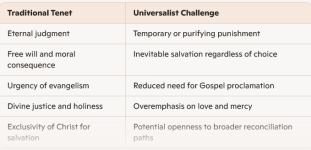
🧱 Summary of Tensions


Traditional TenetUniversalist Challenge
Eternal judgmentTemporary or purifying punishment
Free will and moral consequenceInevitable salvation regardless of choice
Urgency of evangelismReduced need for Gospel proclamation
Divine justice and holinessOveremphasis on love and mercy
Exclusivity of Christ for salvationPotential openness to broader reconciliation paths


Christian Universalism and Calvinism


Christian Universalism and Calvinism share key theological similarities, especially around God's sovereignty and the efficacy of Christ's atonement, though they diverge sharply on the scope of salvation.
Here’s a breakdown of their surprising points of overlap and where they part ways:

🔗 Shared Theological Ground
1. Divine Sovereignty
Calvinism: God is absolutely sovereign; His will cannot be thwarted. He elects some for salvation, and His grace is irresistible for the elect.
Universalism: Also affirms God’s sovereignty—but extends it to assert that God’s will to save all will ultimately prevail.
Common Ground: Both reject the idea that human free will can ultimately override God’s redemptive plan.
2. Monergism (God Alone Saves)
Calvinism: Salvation is entirely God’s work, from election to glorification.
Universalism: Similarly sees salvation as God’s initiative and accomplishment, not dependent on human merit or decision.
Common Ground: Both emphasize that salvation is not earned but given by grace.
3. Christocentric Atonement
Calvinism: Christ’s atonement is sufficient for all but efficient only for the elect.
Universalism: Christ’s atonement is both sufficient and effective for all.
Common Ground: Both see the cross as central and powerful—Universalists simply apply that power universally.

⚔️ Where They Diverge
DoctrineCalvinismUniversalism
Scope of SalvationLimited to the electExtended to all people
View of HellEternal conscious tormentTemporary, purifying, or metaphorical
Human ResponseIrresistible grace for the electAll will eventually respond to grace
ElectionGod chooses someGod chooses all


🧠 Theological Tension: Calvinism’s “Logic Drift”?

Some theologians argue that Calvinism’s internal logic—if God’s will is always accomplished and Christ’s atonement is effective—should lead to Universalism. Karl Barth and Friedrich Schleiermacher, both influenced by Reformed theology, leaned toward universalist conclusions for this reason.
Roger Olson provocatively noted that to avoid Universalism, Calvinists must accept that God could save all but chooses not to—a view some find morally troubling.

🧭 Summary

While Calvinism and Universalism differ profoundly in their conclusions, they share a high view of God’s sovereignty, the centrality of Christ, and the monergistic nature of salvation. In fact, some Universalists see themselves as “consistently Calvinist”—just without the limit on grace.
 
Last edited:
Top Bottom