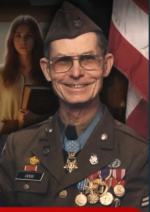
They had seen him:
• crawl through smoke to reach the wounded
• drag men to the cliff edge under machine‑gun fire
• lower them down the escarpment one by one
• pray aloud for strength when everyone else had given up
They had seen him do the impossible.
And now, on the morning of the next assault, the order came:
“Company B, prepare to move out.”
The men lined up.
Checked their gear.
Loaded their rifles.
But they didn’t move.
The officers looked around, confused.
“Why aren’t you men going up?”
A sergeant stepped forward — one of the same men who once tried to get Doss kicked out of the Army.
He said quietly:
“We’re waiting for Doss.”
The officers blinked.
“What do you mean, waiting for Doss?”
The sergeant answered:
“We’re not going up there without him.
Not again.
Not without the man who prays for us.”
Doss wasn’t there yet.
It was Saturday morning — the Sabbath.
He was finishing his prayer time.
The entire company — hardened soldiers, battle‑scarred veterans, men who had seen death up close — stood silently and waited.
No one moved.
No one argued.
No one climbed the ridge.
They waited for the unarmed medic who had saved them all.
When Doss finally arrived, carrying nothing but his medic bag and his Bible, the men stepped aside to let him pass. Some nodded. Some touched his shoulder. Some simply breathed easier.
Then the captain said:
“Doss, would you pray for us?”
He did.
And only after he finished did the company climb the ropes and go back into the fire.
 THE STORY OF THE LOST BIBLE
The moment the company proved how much they loved the man who saved them.
It happened at the end of the Battle of Okinawa — after the grenades, after the sniper shot, after the night he saved 75 men on Hacksaw Ridge.
Doss had finally been evacuated.
He was broken, bleeding, and barely alive:
• grenade shrapnel in his legs
• a sniper bullet through his arm
• infection setting in
• fever rising
As the medics carried him away, he realized something:
His Bible — the one he read every morning and every night — was gone.
It had fallen somewhere on the ridge.
Somewhere in the mud, the smoke, the blood, the chaos.
For Doss, that Bible wasn’t just a book.
It was:
• his anchor
• his courage
• his comfort
• his connection to God
• the source of every prayer he prayed over the men he saved
He whispered to the medic beside him:
“I lost my Bible.”
He didn’t complain.
He didn’t ask for help.
He simply mourned it — quietly, the way he lived.
THE COMPANY’S REACTION
The men who once mocked him now risked their lives for him.
When the men of Company B heard that Doss had lost his Bible, something extraordinary happened.
These were hardened soldiers.
Men who had survived:
• Guam
• Leyte
• Okinawa
• Hacksaw Ridge
Men who had watched friends die.
Men who had been saved by Doss’s hands.
And without hesitation, they said:
“We’re going back for it.”
Not for a weapon.
Not for a map.
Not for a radio.
For his Bible.
They climbed back onto the ridge — the same ridge where so many had fallen — and began searching through:
• mud
• shell craters
• burned brush
• blood‑soaked earth
They searched under fire.
They searched in danger.
They searched because they loved him.
And then — one of them found it.
Doss’s Bible, scorched at the edges, stained with dirt and smoke, but intact.
They carried it back down the ridge like a treasure.
When they reached the aid station, they placed it in Doss’s hands.
He wept.
MEDAL OF HONOR — DESMOND THOMAS DOSS
Awarded by President Harry S. Truman on October 12, 1945
Below is a concise, chronicle‑ready summary of the Medal of Honor he received for his actions on Okinawa. This is not the full copyrighted citation — just a faithful summary of the key elements.
President Harry Truman awarded him the Medal of Honor, saying:
“I consider this a greater honor than being President.”
Doss became:
• the first conscientious objector to receive the Medal of Honor
• one of the most decorated medics in U.S. history
• a global symbol of faith under fire
 Summary of the Medal of Honor Citation
Desmond T. Doss, Private First Class, United States Army, received the Medal of Honor for extraordinary heroism and devotion to duty during the Battle of Okinawa, April–May 1945.
His citation highlights that:
1. He repeatedly risked his life under intense enemy fire
Doss exposed himself to machine‑gun, mortar, and rifle fire to reach wounded soldiers who had fallen in exposed positions.
2. He treated and evacuated the wounded under impossible conditions
He bandaged, stabilized, and carried men to safety while shells burst around him.
3. He saved approximately 75 men on Hacksaw Ridge
When his unit was forced to retreat, Doss remained behind alone, lowering wounded soldiers down a 400‑foot cliff using a rope sling he tied himself.
4. He refused to abandon the battlefield even after being wounded
• He was hit by grenade shrapnel but crawled to treat another soldier.
• He was shot by a sniper while being carried off the field and insisted another wounded man be taken first.
• He fashioned a splint for his own shattered arm and crawled to safety.
5. His actions inspired his entire company
His courage, faith, and selflessness saved hundreds of lives and strengthened the morale of every soldier around him.
6. He performed all of this without carrying a weapon
Doss was the first conscientious objector in American history to receive the Medal of Honor.
DESMOND DOSS — LIFE AFTER THE ARMY
A quiet hero who carried his faith into the rest of his life.
When Desmond Doss left the battlefield in 1945, he didn’t return as a celebrity or a man seeking recognition. He returned as a wounded soldier with a gentle spirit, a deep faith, and a body permanently marked by war.
1. A Life Marked by Injury and Sacrifice
Doss came home with:
• shrapnel in his legs
• a sniper‑shattered arm
• chronic pain
• recurring infections
• and later, tuberculosis
The tuberculosis cost him a lung and five ribs.
He spent years in hospitals recovering.
But he never complained.
He saw his survival as a gift from God.
2. A Simple Life in Rural Alabama
After recovering, Doss settled in Rising Fawn, Georgia, and later in Alabama, choosing a quiet, rural life far from the spotlight.
He worked:
• as a carpenter
• as a farmer
• as a small‑scale craftsman
He lived simply, humbly, and gratefully.
He never sought fame.
He never boasted.
He never cashed in on his story.
3. A Devoted Husband and Father
Doss married Dorothy Schutte, the woman who had supported him through the war and his long recovery.
Together they had one son, Desmond Jr.
Dorothy was his anchor — until her tragic death in 1991 in a car accident.
Doss later remarried Frances Duman, who cared for him in his final years.


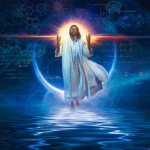
 Biblical Principle: God Creates by Word → Scientific Parallel: Constants as the “Numerical Speech” of Reality
 Biblical Principle: God Sustains All Things → Scientific Parallel: Constants Maintain Stability
 Biblical Principle: God Is Not the Author of Confusion → Scientific Parallel: Constants Produce Order, Not Chaos
 Biblical Principle: The Logos Is the Rational Structure of Creation → Scientific Parallel: Constants Are the Mathematical Expression of Logos
 Biblical Principle: Creation Declares God’s Glory → Scientific Parallel: Fine‑Tuning as Testimony
 Biblical Principle: God Sets Boundaries → Scientific Parallel:
 Biblical Principle: God Is Unchanging → Scientific Parallel: Constants Are (So Far) Unchanging
 Biblical Principle: Creation Is Contingent, Not Necessary → Scientific Parallel: Constants Could Have Been Otherwise
 Biblical Principle: Wisdom Built the Universe → Scientific Parallel: Constants Form a Coherent System