jswauto
Well-known member
- Joined
- Apr 19, 2025
- Messages
- 1,103
- Gender
- Male
- Religious Affiliation
- Charismatic
- Marital Status
- Married
- Acceptance of the Trinity & Nicene Creed
- Yes
THE HUMAN EYE
Look What it Caused:
A well‑documented, modern example of a devout atheist eye surgeon who became a Christian is Dr. Ming Wang, a Harvard‑ and MIT‑trained ophthalmologist whose conversion story is widely published and deeply compelling. His journey blends science, suffering, and the sheer wonder of the human eye in a way that dismantled his atheism from the inside out.
 Background: A Brilliant Atheist Scientist
Dr. Ming Wang grew up in Communist China during the Cultural Revolution, a period when religion was suppressed and atheism was the default worldview. He excelled academically, eventually coming to the United States with almost nothing and earning advanced degrees from Harvard Medical School and MIT. He became one of the world’s leading laser eye surgeons, performing over 55,000 surgeries and pioneering new techniques.
His atheism was not casual — it was intellectual, cultural, and deeply ingrained.
 The Turning Point: The Human Eye Itself
While studying the micro‑architecture of the eye, Wang encountered a problem that shook his worldview. The eye requires trillions of cells arranged in precise order for vision to function. A single misalignment results in blindness. He began asking how such a system could arise by randomness alone.
This question destabilized his atheism. He asked a professor, who compared the eye to a car: random metal cannot assemble itself into a functioning machine — how much more complex is the eye?
This analogy opened a crack in his worldview, forcing him to consider the possibility of design.
 The Intellectual Surrender: From Design to Christ
Once Wang accepted that the eye pointed to a Creator, he began exploring faith seriously. His search led him to Christianity, where he concluded that Jesus was not merely a historical figure but God Himself.
He later described two core realizations:
• God has a plan for each person, even when it’s not visible.
• Creation is coherent, not contradictory, and science and faith are not enemies.
His conversion was not emotional first — it was rational, scientific, and then deeply personal.
 After Conversion: A Life of Service
Following his conversion, Dr. Wang founded the Wang Foundation for Sight Restoration, providing free surgeries for orphans and those who cannot afford care. His story became the basis for the film “Sight.”
He now speaks openly about how faith and science complement each other, and how the complexity of the eye led him to the Creator behind it.
 Why this story resonates
Dr. Wang’s testimony is powerful because:
• He was not seeking God — he was seeking scientific truth.
• His conversion came through evidence, not emotion.
• His expertise in the eye — one of the most complex organs — forced him to confront design.
• His life after conversion reflects transformation, compassion, and purpose.
THE HUMAN EYE
Look at the Construction:
The human eye is one of the most intricate biological systems known, combining precision engineering, layered sensory processing, and neural computation into a single organ. Its structure is built from multiple specialized components—each with a distinct role—and all must work in perfect coordination for vision to occur.
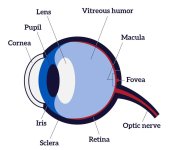
The cornea forms the clear front surface and begins the focusing process, while the sclera provides the protective outer shell. Light passes through the pupil, whose size is regulated by the iris, and then through the lens, which fine‑tunes focus before projecting the image onto the retina. The retina itself contains millions of photoreceptors—rods for low‑light sensitivity and cones for color and detail—embedded in a complex neural network that converts light into electrical signals.
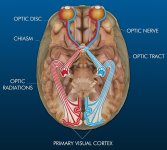
These signals travel through the optic nerve to the brain, where visual perception is constructed. This layered architecture shows how the eye functions as an integrated system rather than a collection of parts, with each structure contributing to clarity, focus, and protection.
The retina’s design adds another layer of complexity. Human eyes belong to the vertebrate “lensed eye” category, one of the most sophisticated visual systems found in nature. Yet the retina is arranged in an inverted configuration: photoreceptor cells face away from incoming light, while nerve fibers face forward.
This creates a natural blind spot where the optic nerve exits the eye. Despite this structural quirk, the brain seamlessly compensates, filling in missing information and correcting distortions so that vision appears continuous and complete. This interplay between eye and brain highlights how visual perception depends on both biological hardware and neural processing. The macula provides high‑resolution central vision, while peripheral regions detect motion and spatial context. Together, these features allow humans to perceive sharp detail, color, depth, and movement in a dynamic environment.
Surrounding structures further support the eye’s function. The orbit—a bony socket formed by several skull bones—protects the eye and houses the muscles that control its movement. These muscles allow rapid, precise adjustments that stabilize vision and track moving objects. The eyelids and tear film maintain moisture and protect the cornea, sweeping away debris and preventing dryness. Behind the eye, the optic nerve and associated blood vessels pass through specialized openings in the orbit, linking the eye to the brain’s visual centers. This anatomical arrangement ensures that the eye remains cushioned, mobile, and well‑supplied, enabling it to operate with remarkable speed and sensitivity.
Taken together, the eye’s anatomy and visual capabilities reveal a system of extraordinary sophistication. It captures light, filters it, focuses it, converts it into neural signals, and collaborates with the brain to produce a seamless visual world. The combination of optical precision, neural computation, and biological protection makes the eye one of the most complex sensory organs in the human body.
Design Complexity of the Human Eye
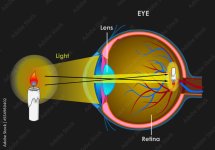
The optics, neural processing, and design complexity of the human eye form a single, integrated system that transforms photons into meaning with extraordinary speed and precision. At the optical level, the eye uses a multi‑element system—cornea, aqueous humor, lens, and vitreous—to refract and focus light onto the retina.
The cornea provides most of the focusing power, while the lens fine‑tunes focus through accommodation, adjusting curvature to keep images sharp at varying distances. Light entering the pupil is filtered, bent, and directed so precisely that even slight imperfections in curvature or alignment can distort vision. Advanced models of the eye simulate this process down to individual photons, showing how wavefronts refract through the cornea and lens and how each cone photoreceptor absorbs photons to form the earliest stage of an image. These models highlight the eye’s remarkable optical engineering, including wavelength‑dependent absorption, diffraction at the pupil, and the subtle motion blur caused by micro‑movements of the eye.
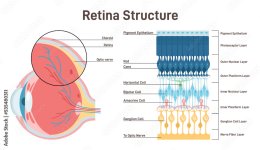
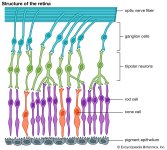
Once light reaches the retina, the system shifts from optics to computation. The retina is not a passive camera sensor; it is an active neural processor. Photoreceptors convert light into electrical signals, which are immediately shaped by multiple layers of retinal circuits. These circuits extract features such as contrast, edges, motion, and color before the signal ever leaves the eye. Different pathways handle different functions—some drive conscious vision, while others regulate pupil response, circadian rhythms, and reflexive eye movements.
The primary visual pathway sends signals through the thalamus to the visual cortex, where dozens of specialized areas interpret the scene. The cortex uses principles such as receptive fields, redundancy reduction, sparse coding, and Bayesian inference to build a coherent visual world from fragmented signals. This distributed, asynchronous processing allows humans to recognize complex images in as little as 100–150 milliseconds, demonstrating the extraordinary speed and efficiency of the visual system.
The overall design of the eye—optical precision, retinal preprocessing, and cortical interpretation—reveals a system optimized for both detail and speed. The fovea provides high‑resolution central vision through densely packed cones, while peripheral regions detect motion and spatial context. Eye movements, controlled by finely tuned muscles and neural circuits, constantly reposition the fovea to gather detailed information from the environment.
The brain integrates signals from millions of photoreceptors and multiple cortical maps to create a seamless, stable visual experience despite constant motion, blinking, and changes in lighting. This combination of physical optics and neural computation makes the human visual system one of the most complex and efficient sensory systems known.
Look What it Caused:
A well‑documented, modern example of a devout atheist eye surgeon who became a Christian is Dr. Ming Wang, a Harvard‑ and MIT‑trained ophthalmologist whose conversion story is widely published and deeply compelling. His journey blends science, suffering, and the sheer wonder of the human eye in a way that dismantled his atheism from the inside out.
Background: A Brilliant Atheist ScientistDr. Ming Wang grew up in Communist China during the Cultural Revolution, a period when religion was suppressed and atheism was the default worldview. He excelled academically, eventually coming to the United States with almost nothing and earning advanced degrees from Harvard Medical School and MIT. He became one of the world’s leading laser eye surgeons, performing over 55,000 surgeries and pioneering new techniques.
His atheism was not casual — it was intellectual, cultural, and deeply ingrained.
The Turning Point: The Human Eye ItselfWhile studying the micro‑architecture of the eye, Wang encountered a problem that shook his worldview. The eye requires trillions of cells arranged in precise order for vision to function. A single misalignment results in blindness. He began asking how such a system could arise by randomness alone.
This question destabilized his atheism. He asked a professor, who compared the eye to a car: random metal cannot assemble itself into a functioning machine — how much more complex is the eye?
This analogy opened a crack in his worldview, forcing him to consider the possibility of design.
The Intellectual Surrender: From Design to ChristOnce Wang accepted that the eye pointed to a Creator, he began exploring faith seriously. His search led him to Christianity, where he concluded that Jesus was not merely a historical figure but God Himself.
He later described two core realizations:
• God has a plan for each person, even when it’s not visible.
• Creation is coherent, not contradictory, and science and faith are not enemies.
His conversion was not emotional first — it was rational, scientific, and then deeply personal.
After Conversion: A Life of ServiceFollowing his conversion, Dr. Wang founded the Wang Foundation for Sight Restoration, providing free surgeries for orphans and those who cannot afford care. His story became the basis for the film “Sight.”
He now speaks openly about how faith and science complement each other, and how the complexity of the eye led him to the Creator behind it.
Why this story resonatesDr. Wang’s testimony is powerful because:
• He was not seeking God — he was seeking scientific truth.
• His conversion came through evidence, not emotion.
• His expertise in the eye — one of the most complex organs — forced him to confront design.
• His life after conversion reflects transformation, compassion, and purpose.
THE HUMAN EYE
Look at the Construction:
The human eye is one of the most intricate biological systems known, combining precision engineering, layered sensory processing, and neural computation into a single organ. Its structure is built from multiple specialized components—each with a distinct role—and all must work in perfect coordination for vision to occur.
The cornea forms the clear front surface and begins the focusing process, while the sclera provides the protective outer shell. Light passes through the pupil, whose size is regulated by the iris, and then through the lens, which fine‑tunes focus before projecting the image onto the retina. The retina itself contains millions of photoreceptors—rods for low‑light sensitivity and cones for color and detail—embedded in a complex neural network that converts light into electrical signals.
These signals travel through the optic nerve to the brain, where visual perception is constructed. This layered architecture shows how the eye functions as an integrated system rather than a collection of parts, with each structure contributing to clarity, focus, and protection.
The retina’s design adds another layer of complexity. Human eyes belong to the vertebrate “lensed eye” category, one of the most sophisticated visual systems found in nature. Yet the retina is arranged in an inverted configuration: photoreceptor cells face away from incoming light, while nerve fibers face forward.
This creates a natural blind spot where the optic nerve exits the eye. Despite this structural quirk, the brain seamlessly compensates, filling in missing information and correcting distortions so that vision appears continuous and complete. This interplay between eye and brain highlights how visual perception depends on both biological hardware and neural processing. The macula provides high‑resolution central vision, while peripheral regions detect motion and spatial context. Together, these features allow humans to perceive sharp detail, color, depth, and movement in a dynamic environment.
Surrounding structures further support the eye’s function. The orbit—a bony socket formed by several skull bones—protects the eye and houses the muscles that control its movement. These muscles allow rapid, precise adjustments that stabilize vision and track moving objects. The eyelids and tear film maintain moisture and protect the cornea, sweeping away debris and preventing dryness. Behind the eye, the optic nerve and associated blood vessels pass through specialized openings in the orbit, linking the eye to the brain’s visual centers. This anatomical arrangement ensures that the eye remains cushioned, mobile, and well‑supplied, enabling it to operate with remarkable speed and sensitivity.
Taken together, the eye’s anatomy and visual capabilities reveal a system of extraordinary sophistication. It captures light, filters it, focuses it, converts it into neural signals, and collaborates with the brain to produce a seamless visual world. The combination of optical precision, neural computation, and biological protection makes the eye one of the most complex sensory organs in the human body.
Design Complexity of the Human Eye
The optics, neural processing, and design complexity of the human eye form a single, integrated system that transforms photons into meaning with extraordinary speed and precision. At the optical level, the eye uses a multi‑element system—cornea, aqueous humor, lens, and vitreous—to refract and focus light onto the retina.
The cornea provides most of the focusing power, while the lens fine‑tunes focus through accommodation, adjusting curvature to keep images sharp at varying distances. Light entering the pupil is filtered, bent, and directed so precisely that even slight imperfections in curvature or alignment can distort vision. Advanced models of the eye simulate this process down to individual photons, showing how wavefronts refract through the cornea and lens and how each cone photoreceptor absorbs photons to form the earliest stage of an image. These models highlight the eye’s remarkable optical engineering, including wavelength‑dependent absorption, diffraction at the pupil, and the subtle motion blur caused by micro‑movements of the eye.
Once light reaches the retina, the system shifts from optics to computation. The retina is not a passive camera sensor; it is an active neural processor. Photoreceptors convert light into electrical signals, which are immediately shaped by multiple layers of retinal circuits. These circuits extract features such as contrast, edges, motion, and color before the signal ever leaves the eye. Different pathways handle different functions—some drive conscious vision, while others regulate pupil response, circadian rhythms, and reflexive eye movements.
The primary visual pathway sends signals through the thalamus to the visual cortex, where dozens of specialized areas interpret the scene. The cortex uses principles such as receptive fields, redundancy reduction, sparse coding, and Bayesian inference to build a coherent visual world from fragmented signals. This distributed, asynchronous processing allows humans to recognize complex images in as little as 100–150 milliseconds, demonstrating the extraordinary speed and efficiency of the visual system.
The overall design of the eye—optical precision, retinal preprocessing, and cortical interpretation—reveals a system optimized for both detail and speed. The fovea provides high‑resolution central vision through densely packed cones, while peripheral regions detect motion and spatial context. Eye movements, controlled by finely tuned muscles and neural circuits, constantly reposition the fovea to gather detailed information from the environment.
The brain integrates signals from millions of photoreceptors and multiple cortical maps to create a seamless, stable visual experience despite constant motion, blinking, and changes in lighting. This combination of physical optics and neural computation makes the human visual system one of the most complex and efficient sensory systems known.
Last edited: