The War Room of Your Relationship
The War Room of Your Relationship with God is not a metaphor—it’s a spiritual reality. It’s the place where battles are fought and won in prayer, where strategies are revealed, and where intimacy with the Commander is forged in fire. It’s where you stop reacting to life and start waging war for your soul, your family, your calling, and your world.
 What Is the War Room?
It’s your sacred space—physical or spiritual—where you meet with God to:
•
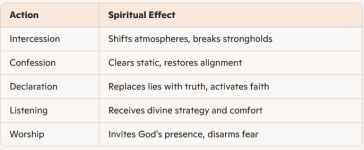
Intercede for others and yourself
•
Strategize with heaven’s wisdom
•
Declare God’s promises over chaos
•
Worship through the storm
•
Listen for divine orders
It’s not about the size of the room—it’s about the posture of your heart.
 How to Build Your War Room
1. Designate the Space
• A literal closet, corner, or chair—or a mental sanctuary you enter with intention.
• Keep it uncluttered, focused, and sacred.
2. Stock Your Arsenal
•
Bible: Your sword of the Spirit.
•
Prayer journal: Track battles, breakthroughs, and promises.
•
Declarations: Scripture-based truths to speak aloud.
•
Worship playlist: Songs that stir your spirit and silence fear.
•
Names and needs: A list of people and causes you’re contending for.
3. Establish Rhythms
•
Morning strategy sessions: “Lord, what’s today’s assignment?”
•
Midday recalibrations: “What are You saying now?”
•
Nightly debriefs: “Where did I see You move today?”
 What Happens in the War Room?
 “War Room Blueprint”
• The architecture of a spiritual war room (altar, map wall, prayer desk, Scripture banners)
• Battle rhythms (daily, weekly, crisis response)
• Historical parallels (e.g., Daniel’s window, Jesus in Gethsemane, Rees Howells’ intercession during WWII)
• Modern applications (family restoration, cultural resistance, spiritual awakening)
The Mechanics
The mechanics of your relationship with the Lord are the spiritual systems, rhythms, and feedback loops that keep your connection alive, growing, and resilient. Just like a vehicle or a war room, this relationship has moving parts—each designed to align your heart, mind, and body with the will and presence of God.
Here’s a breakdown tailored for your relationship building—structured, actionable, and ready for spiritual battleground integration:
 The Mechanics of Your Relationship with the Lord
1.
Alignment (Spiritual Calibration)
•
Purpose: Ensures your heart is synced with God’s will.
•
Mechanism: Daily surrender, Scripture immersion, confession.
•
Feedback Loop: Peace, clarity, conviction.
•
Scripture Anchor: “Search me, O God… lead me in the way everlasting.” (Psalm 139:23–24)
2. Intake (Spiritual Fuel System)
•
Purpose: Feeds your spirit with truth and power.
•
Mechanism: Word of God, worship, teaching, testimonies.
•
Feedback Loop: Renewed mind, strengthened faith, spiritual hunger.
•
Scripture Anchor: “Man shall not live by bread alone…” (Matthew 4:4)
3. Output (Obedience System)
•
Purpose: Converts faith into action.
•
Mechanism: Service, evangelism, justice, generosity.
•
Feedback Loop: Fruitfulness, joy, spiritual authority.
•
Scripture Anchor: “Faith without works is dead.” (James 2:17)
4. Communication (Prayer Circuitry)
•
Purpose: Maintains two-way connection with God.
•
Mechanism: Listening, intercession, declaration, lament.
•
Feedback Loop: Revelation, comfort, divine strategy.
•
Scripture Anchor: “Call to Me and I will answer you…” (Jeremiah 33:3)
5. Maintenance (Spiritual Diagnostics)
•
Purpose: Identifies and repairs spiritual wear and tear.
•
Mechanism: Fasting, solitude, accountability, Sabbath.
•
Feedback Loop: Healing, restoration, recalibration.
•
Scripture Anchor: “Examine yourselves to see whether you are in the faith…” (2 Corinthians 13:5)
6. Activation (Embodied Worship System)
•
Purpose: Engages the body in spiritual expression.
•
Mechanism: Movement, breath, posture, praise.
•
Feedback Loop: Emotional release, spiritual breakthrough, deeper intimacy.
•
Scripture Anchor: “Let everything that has breath praise the Lord.” (Psalm 150:6)
 “Spiritual Engine Overlay”
Imagine this diagram like a spiritual engine:
•
Fuel lines = Word and worship
•
Ignition = Prayer
•
Drive shaft = Obedience
•
Sensors = Conviction and peace
•
Exhaust system = Confession and release
•
Cooling system = Sabbath and rest
 Spiritual Toolbox: Core Tools for the Workshop of Faith
Let’s step into the workshop of the soul and design a Spiritual Toolbox—a curated set of tools for restoration, resistance, and relationship with the Lord. This toolbox isn’t metaphorical—it’s tactical, modular, and ready to be deployed in your life.
Spiritual Toolbox: Core Tools for the Workshop of Faith
Let’s step into the workshop of the soul and design a Spiritual Toolbox—a curated set of tools for restoration, resistance, and relationship with the Lord. This toolbox isn’t metaphorical—it’s tactical, modular, and ready to be deployed in your life.
1.
 The Hammer of Truth
•
Function: Breaks lies, strongholds, and confusion.
•
Use: Speak Scripture aloud. Declare God’s promises over fear, shame, or deception.
•
Verse: “Is not My word like a hammer…?” (Jeremiah 23:29)
2.  The Chisel of Conviction
•
Function: Shapes character, exposes hidden sin, refines motives.
•
Use: Invite the Holy Spirit to search and reveal. Journal what He shows.
•
Verse: “He will convict the world of sin…” (John 16:8)
3.
The Level of Alignment
•
Function: Ensures your life is aligned with God’s Word and Spirit.
•
Use: Regular self-examination, accountability, and Scripture calibration.
•
Verse: “Examine yourselves to see whether you are in the faith…” (2 Corinthians 13:5)
4.
The Wrench of Repentance
•
Function: Loosens hardened places, tightens loose convictions.
•
Use: Confess, turn, and adjust. Repentance is not shame—it’s recalibration.
•
Verse: “Repent… that times of refreshing may come.” (Acts 3:19)
5.
 The Mirror of Identity
•
Function: Reflects who you are in Christ.
•
Use: Meditate on identity Scriptures. Reject false labels.
•
Verse: “We all… are being transformed into His image…” (2 Corinthians 3:18)
6.
 The Oil of Intimacy
•
Function: Lubricates relationship with the Lord—keeps it tender, flowing, alive.
•
Use: Worship, stillness, listening prayer. Protect against burnout.
•
Verse: “Your anointing teaches you about all things…” (1 John 2:27)
7
.  The Ladder of Intercession
•
Function: Connects heaven and earth. Builds bridges for others.
•
Use: Pray strategically for people, cities, nations, and movements.
•
Verse: “I looked for someone to stand in the gap…” (Ezekiel 22:30)
8. The Compass of Calling
•
Function: Points toward purpose and mission.
•
Use: Discern your assignment. Ask: “What is my role in this season?”
•
Verse: “Before I formed you… I appointed you…” (Jeremiah 1:5)



 Core Attributes of Christlikeness
 Foundational Practices
 Deepening the Connection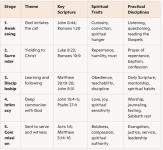
 Dependency: You can’t surrender to a Savior you haven’t yet encountered.
 Visual Flow Concept
 Just Jesus Means…
 1. Repentance — The Reset Button
 3. Prayer — Your Emergency Line
 4. Worship — Your Oxygen Mask
 6. Fellowship — Your Support Team
 7. Memory Verses — Your Quick-Access Arsenal
 8. Fasting — Your Spiritual Defibrillator
 9. Identity in Christ — Your Core Stabilizer
 10. Eternal Perspective — Your Compass
 Spiritual Triage Chart
 Coldness Toward God
 Spiritual First Aid: Field Application Guide
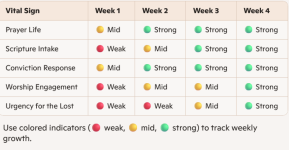
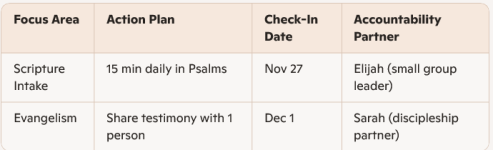
 Spiritual Recovery Tracker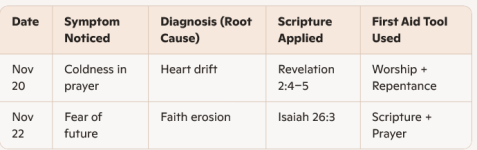
 2. Vital Signs Progress Chart